
Responsible Conspiracy Theorizing

Responsible Conspiracy Theorizing is Eric Weinstein's proposed discipline for investigating possible covert coordination without turning suspicion into certainty. It joins historical awareness, competing hypotheses, explicit uncertainty, demands for primary evidence, and willingness to abandon a hypothesis. Its central distinction is between "this is suspicious and historically plausible" and "we know exactly what happened."
Eric develops the approach in discussions of intelligence, Epstein, UFOs, COVID, elections, and institutional narrative control. His 2016 Sam Harris conversation introduces historical examples and "Camping and Decamping"; a 2017 Rubin interview emphasizes recognizing artificiality without pretending to know its precise cause. He explicitly uses the Responsible Conspiracy Theorizing label in a 2019 X post and later conversations.
Eric's Main Takes[edit]
Historical Precedents[edit]
Eric says intelligent people must recognize that real conspiracies exist. He invokes COINTELPRO, MKUltra, Operation Paperclip, Tuskegee, Iran-Contra, Fred Hampton, and Jean Seberg to challenge the assumption that an initially implausible story must be false. His Type 1/Type 2 error framing asks investigators to take both false suspicion and missed covert action seriously.
He recommends staying close to known structures: Los Alamos, Rad Lab, dummy and shell companies, covert influence campaigns, and intelligence cutouts. Special access programs, unacknowledged special access programs, and waived unacknowledged special access programs are his examples of formal secrecy arrangements.
Explore a Hypothesis and Leave It Again[edit]
"Camping and decamping" means temporarily inhabiting a possibility, then stepping outside it and steelmanning alternatives. Eric connects this to Arthur Koestler's "screamer" problem: people can fail to respond even to genuine horrors, but moral urgency does not remove the need to test an explanation.
He also separates recognizing a distortion from identifying its cause. In the Rubin and Gutfeld discussions, one may judge a public performance artificial without inventing the memo, meeting, agency, or mechanism behind it. "If not X, then what?" does not oblige an investigator to supply a complete replacement story. "I don't know" can be the responsible answer.
Decision Trees and the Epstein Case[edit]
Eric's Epstein discussions distinguish an abnormal pattern from a settled account of its cause. He questions whether ordinary incompetence heuristics adequately explain institutional behavior, compares institutional non-response to an indirect dark-matter inference, and challenges the public currency-trader/rich-patron story.
In Portal Ep. 025, Eric lays out hypothetical branches concerning Epstein's reported death: dead or not dead, own hand or another's, and possible induced suicide or murder, with fear, shame, or duty among the proposed motives. His discussions of the Amy Robach tape, financial and regulatory records, and media silence ask what evidence institutions should investigate.
Stigma Is Not an Evidentiary Test[edit]
Eric argues that words such as crank, nutter, grifter, and charlatan can deter inquiry when careers and platforms depend on avoiding them. Lex 134 treats the silence surrounding Epstein as something to map and asks what wrongdoing becomes harder to examine when no one can afford to say "conspiracy."
Eric also rejects careless claims, bad arithmetic, sloppy UFO material, and low-quality narratives attached to real questions. In the Josh Szeps conversation, he calls QAnon dangerous and argues for hearings and primary data.
Keep Branches Open Without Abandoning Adjudication[edit]
The UFO conversations distinguish hearsay from data and consider anomalous craft, hidden terrestrial technology, official disinformation, and failures of public trust. Eric argues that several branches could matter institutionally. His later discussions of COVID origins, the Warren Report, Ukraine, malinformation, and sources-and-methods secrecy extend that demand for evidence rather than automatic dismissal.
In Portal Ep. 042, Eric says widespread fraud has not been demonstrated while criticizing asymmetric treatment of election suspicions and Trump-Russia claims. After January 6, he argues that historical misconduct can explain distrust without authorizing endlessly added hypotheses to override courts and the Supreme Court. JRE 1628 rejects both simplistic official certainty and a single partisan hidden-story explanation.
Oversight and Disclosure[edit]
Eric favors hearings, accountable investigation, oversight, and appropriately interpreted disclosure. In the 2024-2025 Piers conversations, he raises questions about Trump assassination attempts, Epstein/JFK/Ukraine fears, New Jersey drones, USAID, and Ryan Routh, and considers possible patsies and pre-planted stories. He warns that disclosure without interpretation can generate new errors, just as reflexive secrecy can deepen suspicion.
Quotes[edit]
Who are these people who know all this stuff? Why am I out of this club? Everybody knows stuff about what's happening in November. I mean, the last time I was on the program I said, "It's a million years [until November]. Donald Trump was almost killed by an AR 15. Joe Biden has been suffering with some level of dementia that's been progressing through his entire term in office." Well, when was the last time you saw MSNBC with five geriatric neurologists watching his gait, his speech and telling you their professional opinions from publicly available data? You're in the magic show, baby. And the funny part about it is, the reason I don't want to hybridize with anyone else is that Responsible Conspiracy Theorizing is very much an adult activity. Responsible Conspiracy Theorizing is not based on saying, "well, I've got the certainty over here and I've lost it because I know I'm being lied to. So I can tell you exactly what is going on. It's the lizard people." Responsible Conspiracy Theorizing says, "I know that the story makes sense, and I know that I don't know how to correct it."
- Eric Weinstein on Chris Williamson #833 on Sept 2, 2024
Given that conspiracies exist in the world, why is it that we don't have people who are Responsible Conspiracy Theorists? My claim is that people tend to be pushed, once they start considering whether something is really wrong, to give their version of events. And my belief is that I don't have to explain—I don't owe you an explanation of what Jeffrey Epstein was. I can tell you what he almost certainly was not. He portrayed himself as a Currency Trader, with an extensive operation run out of I think Villard House in Manhattan. I do not believe that anyone has given a coherent picture of his trading prowess, who his counterparties were, where he did prime brokerage. I have heard no discussion of records recovered from Villard house. I don't believe that it is likely that his fortune came from trading as he was portraying. I don't believe that he was particularly interested in either trading or deeply in science, although he was very interested in collecting scientists, for his intellectual life or social life or some purpose, it's not clear.
- Eric Weinstein on The Jolly Swagman #78 on January 30, 2020
I believe that if you would review the video—where is it from, Dubai or Abu Dhabi?—of the mysterious hit on the hotel guest—you ever seen this thing?—No. Oh, it's the assassination in 2010, 10 years ago, of Mahmoud al-Mabhouh, something like that, in Dubai, where I believe 26 separate individuals on multiple teams are shown converging, coming in from all over the world on false passports, pretending to be tennis players or, you know, business people or vacationers. And all of these teams have different functions. And they murder this guy in his hotel room. And the Dubai guest chief of police security officer was so angered that he put together this amazing video that says, "We can completely detail what you did. We caught you on closed circuit TV. We don't know exactly who you are, because of your disguises and your false passports. But yeah, 26 people converged to kill one." No, I don't believe you. I don't believe, after CoIntelPro, and Operation Paperclip, and Operation Mockingbird—I don't know whether I should even bring up Rex 84—to not believe in conspiracies is an idiocy.
First of all, when evil wants to operate at scale, it needs to make sure that people don't try to figure out evil. When evil operates at scale, from first principles, you have to realize that evil must not want it[self] investigated. The most efficient way to keep yourself from being investigated, if you are an evil institutional player who needs to do this repeatedly, is to invest in a world in which no one can afford to say the word "conspiracy". You will notice that there is a special radioactivity around the word "conspiracy". We have provable conspiracies, we have admitted to conspiracies, you have been invited to conspiracies. There is no shortage conspiracies are everywhere. Some of them are mundane. Some of them are like price fixing cartels, you know, or trade groups are, generally speaking, conspiracies. So the first thing you have to realize is that all of us are in a memetic complex where you can be taken off the chessboard by saying "conspiracy theory". Get done. It's like a one line proof: "We don't have to listen to Lex. He said he was a conspiracy theorist on this show." Okay. That is partially distorting our conversation. If you want to ask me about Jeffrey Epstein, you have to agree with me that that is a logical description of what you would have to have if you wanted to commit conspiracies, is that you have to make sure that people are dissuaded from investigating....
My point there is Responsible Conspiracy Theorizing, where you look at the history of unearthed conspiracies, and just like you would with any other topic, just think about how different the rules in your mind are for conspiracy theorizing versus x theorizing where x can be anything. Right? It's like if I say to you— I can say the statement that "average weight is not the same between widely separated populations". You'd say, "Yeah", I'd say "average height is not the same between widely separated populations". You'd say "yeah", and I say, "in fact, no continuous variable that shows variation should be expected to be identical between widely separate—", "Of course, Eric", "Like IQ." "Whoa, whoa, whoa, hold on." Right? So we have a violent reaction to specific topics. So the first thing I want to do is just to notice that "conspiracy" has that built into everyone's mind.
I just watched the film 1971 about my favorite conspiracy of all time, I highly recommend it. The film is titled "1971", and it's about the Citizens Committee to Investigate the FBI, which was run by a student of Murray Gell Mann, a physicist, and broke into FBI offices in Pennsylvania to steal files, which allowed Freedom of Information requests that discovered a huge conspiracy. It was a conspiracy that unearthed a conspiracy inside the federal government, a double conspiracy story, which launched multiple conspiracies. I think that the problem with modern Americans is that they are so timid, that they don't even learn about the history of conspiracies that we have absolutely proven. So with that done, Jeff Epstein, in my opinion, represented somebody's construction.
- Eric Weinstein on Lex Fridman #134 on Oct 29, 2020
Now I want to say, first of all, that I have absolutely no special inside knowledge of the situation. I know people who knew him and I met him once, but it is not like I have any particular line on information from any particularly interesting source about the situation. Furthermore, I don’t think that I’m going to be using any special kind of analysis that is known only to me, but I did want to talk to people about responsible conspiracy theorizing. That is, in the minds of many, people believe that conspiracy theorists are people like Alex Jones, people who are spouting all sorts of crazy ideas-some of which might have some grain of truth in them, but in general it feels like an exercise in talking to the tin foil hat crowd.
Now, I don’t know much about Alex Jones; perhaps he’s better than I think he is, but what I want to talk about is a different kind of conspiracy theorizing. So, without further ado, welcome to this episode of The Portal on the subject of Jeffrey Epstein.
So the first thing I want is to be relatively clear: I’m somebody who believes that there is a fair amount of organization behind the scenes-usually of a relatively low level of organization-that is unknown to the people who are watching TV or listening to, let’s say, NPR on the radio. And at various times I’ve dug more deeply into various stories, and so I want you to have some idea of my history in the space.
In the 1980s and 1990s, I became very active in believing that the so called STEM shortage of scientists and engineers that was claimed by the policy research and analysis division of the National Science Foundation, was in fact a conspiracy in order to make life easier for employers who would be facing American scientists with an ability to bargain, and make higher wage demands; and that the National Academy of Sciences and National Science Foundation interceded on the behalf of employers, which was tampering in the labor market in an absolutely vital sector-resulting in the Immigration Act of 1990, or IMMACT90, as it was called.
At that point, I also became aware of what I have termed the Borjas Rectangle Theory: that is that employers generally, in free market economies, when they’re complaining about labor shortages, are actually trying to transfer wealth from labor to capital-complaining instead that there is a small inefficiency that needs to be rectified, which we might [in turn] call the Harberger Triangle. So that is, employers claim that there’s a small inefficiency, but in [point of] fact they’re seeking large transfer payments from the vulnerable to the well-heeled. I also believe that NAFTA and the Free Trade Agreement from the 1990s, was a kind of conspiracy supported by the economics establishment of the United States; that they knew that in fact free trade was not a freebie. It was not in fact a rising tide that lifted all boats, but was in fact, again, a transfer, which was claimed to be a pure good for everyone. This is the difference between something called the Kaldor-Hicks objective function and the Pareto objective function.
I also believed that String Theory was largely a desperation measure in physics that was sold to the world to buy time, when in fact the field of theoretical physics was failing. I also claimed that the Boskin Commission, formed by Packwood and Moynihan in the mid-1990s, was a kind of conspiracy to transfer, actually, a trillion dollars, by using the fact that Social Security payments are indexed to inflation, as well as tax brackets being indexed to inflation; so that if you could show that the CPI was overstated and you could reduce the CPI, you could transfer millions without having to touch the so called “third rail” of American politics.
This brings us to the two trading fortunes in New York City that, during the first decade of the new millennium, made no sense to me. And those were Bernie Madoff, then referred to as the “Jewish T-Bill”, and Jeffrey Epstein. In the case of Madoff, I made a wrong guess. I believed that Bernie Madoff was frontrunning a traditional business that he held using actual orders that he knew were being placed, and in his hedge fund [he] was effectively cheating-based on the inside information he had from a legitimate business, in an illegitimate business. I goofed, and I was wrong. In fact, he was operating a pyramid scheme. It didn’t occur to me.
Eric Weinstein, March 7, 2020, on The Portal Ep #25
On X[edit]
2019[edit]

Wait, what? This is a totally adorable 2019 tweet! Be sure to tell, @1971Film, @carlbernstein, @danielsheehan45, @HarryMarkopolos, @ErinBrockovich, etc. and let me know how you make out. But be sure to read all documents at: https://www.industrydocuments.ucsf.edu/tobacco/about/ first.
This *never* goes away.

Conspiracy theories are there for people who can't handle or solve real world problems.
I would love to debate fellow IDW member @michaelshermer on responsible conspiracy theorizing for adults. Could be a blast. Michael you are welcome on the portal any time to discuss this.
2020[edit]
I am looking forward to making a LOT of apologies. Nothing would make me happier as a responsible conspiracy theorist.
I have been told of metallic samples with strange mixtures of elements not found in nature by respected professors in STEM and did not know what to believe.
2022[edit]


…but then in Aix, once you see one AIX or X reference, you start seeing things everywhere that may or not be real.


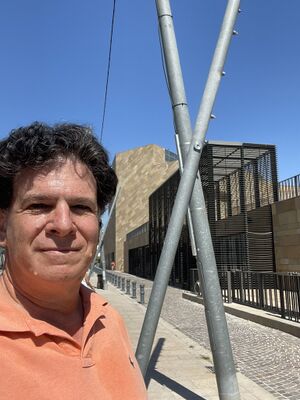
This is a simple model of what goes wrong in most models of “conspiracy theorizing”. I don’t know how to say that the building pictured is almost certainly an “architectural conspiracy” to spell AIX while the gate is not. I have no idea about the crossed metal beams.
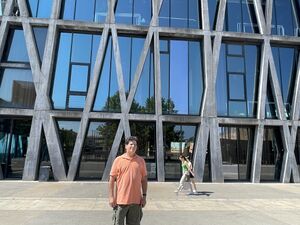

Moral: some people seem to see meaning & pattern everywhere. Others seem to demand proof because they believe that it’s all likely our imaginations. Don’t be like those groups of people.
Take on the true burden of trying to sort out what is real but hidden vs what is imagined.🙏
2024[edit]
There is an old suite of ideas from a different time:
What appears to be coordinated is actually emergent.
What appears to be malice is actually incompetence.
What appears to be a pattern is generally random.
What appears to be doable outside of markets isn’t worth attempting because it can’t be coordinated and/or it is against human nature and/or has too many unintended consequences. ——
When enough people were educated to believe that suite as a sign of membership in the sophisticated elite, it then became possible to weaponize those ideas because they all shared a hidden feature: enervation.
People too sophisticated to believe in conspiracies, blame, patterns or the possibility of change will not only tend to do nothing, but they will tend to ensure that nothing can be coordinated around them except by narrow self interest. Which means markets/commerce/business is the only thing left.
In this clip, “Is Google trying to influence the 2024 election.” Chris is struggling to point out that it doesn’t require a conspiracy. Of course that is true.
But it is much more helpful to notice that if you have a portfolio of explanations and with allocations to emergence vs coordination, it would be insane to have a zero allocation to conspiracy.
Moral: Learn how to be a responsible conspiracy theorist. There are no lizard people. But there are sure a lot of back channels and algorithms you know nothing about.
NOTE: Zuckerberg’s letter pointing to such a coordination in an earlier election appeared after this was taped. So…
Examples of Unearthed Conspiracies[edit]
- The Barack Obama Senior Harvard Story
- Boskin Commission
- The Swift-and-Devastating-Takedown Story
- The Arxiv
- The Tobacco Industry Story
Related Pages[edit]
- Anechoic Era or Anechoic media
- Anti-Interesting
- Camping and Decamping
- Deaths of Accountability
- Digital Wetwork
- Dual-use research
- Event Deconfliction
- Follow the Silence
- Influence Operation
- Institutional Gaslighting
- Jeffrey Epstein
- Jessupization
- Law of Gaslighting
- Map the Silences
- Neo-Debunker
- Nothing Burger
- Physics got NERPhed
- Prebunked Malinformation
- Seberging
- The Invisible World is First Detected by the Visible World’s Failure to Close
- Tuskegee Principle
- Universal Institutional Betrayal