
Geometric Marginalism: Difference between revisions
No edit summary |
(→On X) |
||
| (One intermediate revision by the same user not shown) | |||
| Line 1: | Line 1: | ||
<blockquote> | <blockquote> | ||
''Another [new economic theory] has to do with bilateral trade and the geometry of markets, culminating eventually in a model of humans in which they're allowed to change their tastes. Now, it sounds very strange to say that economic theory falls apart when human beings change their tastes. But since at least the late 1970s, we've had an excuse in place in the work of Becker and Stigler, that allows us to make assumptions about human beings that are known to be wildly untrue. And the way out, strangely enough, is through differential geometry, the differential geometry of markets. So that's something that I think we're going to be very interested in bringing to you. I don't know whether the idea of geometric markets is something that can be easily explained to a mass audience. But this theory of geometric marginalism is, in fact, a starter theory, that, if that is successful, might allow us to discuss an even more profound attempt, which would be this concept that I've called Geometric Unity.'' | ''Another [new economic theory] has to do with bilateral trade and the geometry of markets, culminating eventually in a model of humans in which they're allowed to change their tastes. Now, it sounds very strange to say that economic theory falls apart when human beings change their tastes. But since at least the late 1970s, we've had an excuse in place in the work of Becker and [[George Stigler|Stigler]], that allows us to make assumptions about human beings that are known to be wildly untrue. And the way out, strangely enough, is through differential geometry, the differential geometry of markets. So that's something that I think we're going to be very interested in bringing to you. I don't know whether the idea of geometric markets is something that can be easily explained to a mass audience. But this theory of geometric marginalism is, in fact, a starter theory, that, if that is successful, might allow us to discuss an even more profound attempt, which would be this concept that I've called Geometric Unity.'' | ||
- Eric Weinstein on [[2: What is The Portal|The Portal Episode 2]] | - Eric Weinstein on [[2: What is The Portal|The Portal Episode 2]] | ||
| Line 14: | Line 14: | ||
{{#widget:Tweet|id=1423392839568789504}} | {{#widget:Tweet|id=1423392839568789504}} | ||
{{Tweet | |||
|image=Eric profile picture.jpg | |||
|nameurl=https://x.com/EricRWeinstein/status/1990534949397803328 | |||
|name=Eric Weinstein | |||
|usernameurl=https://x.com/EricRWeinstein | |||
|username=EricRWeinstein | |||
|content=So to sum it up: he is not wrong. | |||
I think what I said to him is that after the 1950s, [[Inflation|inflation]] became a modern tool/weapon rather than a measurement starting with the [[Price Statistics Review Committee (Stigler Commission)|Stigler Commisson]]. I explained my view that the @BLS_gov is a quiet version of the @federalreserve. An insanely powerful “Statistics” organization where economists actually implement policy by simply chosing how to compute economic numbers. | |||
Numbers that just so happen to automatically transfer trillions and touch every aspect of our lives. | |||
He already knew a lot of the [[Boskin Commission|Boskin]]/[[Gauge Theory|GaugeTheory]] story from Harvard. Less about [[George Stigler|Stigler]] if I remember correctly. | |||
I’d love to ask Larry about all this now. | |||
|thread= | |||
{{Tweet | |||
|image=Eric profile picture.jpg | |||
|nameurl=https://x.com/EricRWeinstein/status/1990530011191992536 | |||
|name=Eric Weinstein | |||
|usernameurl=https://x.com/EricRWeinstein | |||
|username=EricRWeinstein | |||
|content=I believe [[Jeffrey Epstein|Epstein]] is referring implicitly to the “[[Price Statistics Review Committee (Stigler Commission)|Stigler Commission]]” of 1959-1961. | |||
This comes from a phone conversation around 2004. | |||
|quote= | |||
{{Tweet | |||
|image=nkulw-profile-gpcdbDoT.jpg | |||
|nameurl=https://x.com/nkulw/status/1988837873513033941 | |||
|name=noah kulwin | |||
|usernameurl=https://x.com/nkulw | |||
|username=nkulw | |||
|content=“inflation is a concept from the 50s” what did he mean… | |||
|media1=nkulw-X-post-1988837873513033941-G5nFgW9XsAAL4lW.jpg | |||
|timestamp=5:14 AM · Nov 12, 2025 | |||
}} | |||
|timestamp=9:18 PM · Nov 17, 2025 | |||
}} | |||
{{Tweet | |||
|image=Eric profile picture.jpg | |||
|nameurl=https://x.com/EricRWeinstein/status/1990530014107107416 | |||
|name=Eric Weinstein | |||
|usernameurl=https://x.com/EricRWeinstein | |||
|username=EricRWeinstein | |||
|content=In a telephone conversation around 2004, he somehow was already well aware of the [[Boskin Commission|1996 Boskin Commission]] and Harvard Economics department burying our work on [[Gauge Theory]] in economics called “[[Geometric Marginalism]]”. That seemed pretty weird at the time. | |||
With the benefit of hindsight and scrutiny, I now understand that he was connected to AT LEAST two of my colleagues from my time as an Economist in the @HarvardEcon department and @nber. To say nothing of the fact that he was connected to AT LEAST two more of colleagues from my time as an math graduate student in the @HarvardMath department. He was evidently in the background of *everywhere* I was over three and a half decades from 1985-2019. It’s astounding. | |||
I believe from memory what he means is the following: | |||
In the 1950s inflation was not yet the tool of policy that it became after the [[Price Statistics Review Committee (Stigler Commission)|“Price Statistics Review Committee”]] around 1960, and the indexing of Social Security to [[CPI]] in the mid 1970s. It was a simple gauge. | |||
After that time, it became a quiet tool. And a weapon. You could use it to transfer not billions…but trillions. Why? Because a GIANT amount of all U.S. Federal receipts are indexed. | |||
He thought it was funny that we expected our work to be heard given that trillions were being stolen. | |||
I hope that there is a transcript of this conversation as well as the gravity phone calls about [[Theory of Geometric Unity|GU]]. If so, it will likely point back to Litauer and Rosovsky, Jorgenson and Summers. | |||
|timestamp=9:18 PM · Nov 17, 2025 | |||
}} | |||
|timestamp=9:38 PM · Nov 17, 2025 | |||
}} | |||
==See Also== | ==See Also== | ||
Latest revision as of 06:39, 10 February 2026
Another [new economic theory] has to do with bilateral trade and the geometry of markets, culminating eventually in a model of humans in which they're allowed to change their tastes. Now, it sounds very strange to say that economic theory falls apart when human beings change their tastes. But since at least the late 1970s, we've had an excuse in place in the work of Becker and Stigler, that allows us to make assumptions about human beings that are known to be wildly untrue. And the way out, strangely enough, is through differential geometry, the differential geometry of markets. So that's something that I think we're going to be very interested in bringing to you. I don't know whether the idea of geometric markets is something that can be easily explained to a mass audience. But this theory of geometric marginalism is, in fact, a starter theory, that, if that is successful, might allow us to discuss an even more profound attempt, which would be this concept that I've called Geometric Unity.
- Eric Weinstein on The Portal Episode 2
The plan is that we're going to try to take over all of economics by going to the heart of the matter. We're going to look at the most basic theories. And we're going to try to see if we can upgrade. Now, what happened years ago is that marginalism slept through economics. What was marginalism? It was the introduction of the calculus into the analysis of market behavior. So if we have an upgrade of the calculus, there's nothing to suggest that we mathematicians and physicists can't swarm into economics, and rip out every place that they've got one of these old fashioned calculus machines, and replace it with this new thing, to solve problems that they haven't been able to solve.
Eric Weinstein on Gauge Theory and Inflation: Enlarging the Wu-Yang Dictionary (YouTube Content)
On X[edit]

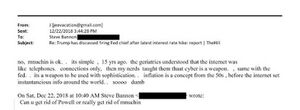
I believe Epstein is referring implicitly to the “Stigler Commission” of 1959-1961.
This comes from a phone conversation around 2004.

In a telephone conversation around 2004, he somehow was already well aware of the 1996 Boskin Commission and Harvard Economics department burying our work on Gauge Theory in economics called “Geometric Marginalism”. That seemed pretty weird at the time.
With the benefit of hindsight and scrutiny, I now understand that he was connected to AT LEAST two of my colleagues from my time as an Economist in the @HarvardEcon department and @nber. To say nothing of the fact that he was connected to AT LEAST two more of colleagues from my time as an math graduate student in the @HarvardMath department. He was evidently in the background of *everywhere* I was over three and a half decades from 1985-2019. It’s astounding.
I believe from memory what he means is the following:
In the 1950s inflation was not yet the tool of policy that it became after the “Price Statistics Review Committee” around 1960, and the indexing of Social Security to CPI in the mid 1970s. It was a simple gauge.
After that time, it became a quiet tool. And a weapon. You could use it to transfer not billions…but trillions. Why? Because a GIANT amount of all U.S. Federal receipts are indexed.
He thought it was funny that we expected our work to be heard given that trillions were being stolen.
I hope that there is a transcript of this conversation as well as the gravity phone calls about GU. If so, it will likely point back to Litauer and Rosovsky, Jorgenson and Summers.
So to sum it up: he is not wrong.
I think what I said to him is that after the 1950s, inflation became a modern tool/weapon rather than a measurement starting with the Stigler Commisson. I explained my view that the @BLS_gov is a quiet version of the @federalreserve. An insanely powerful “Statistics” organization where economists actually implement policy by simply chosing how to compute economic numbers.
Numbers that just so happen to automatically transfer trillions and touch every aspect of our lives.
He already knew a lot of the Boskin/GaugeTheory story from Harvard. Less about Stigler if I remember correctly.
I’d love to ask Larry about all this now.
See Also[edit]
 This article is a stub. You can help us by editing this page and expanding it.