
Peer Review
Peer review is a relatively new form of gatekeeping used by the DISC to suppress ideas. It functions to keep out bad ideas and amplify good ideas. Like any human process, it fails in its function at times. It sometimes amplifies bad ideas such as those exposed by the Grievance Studies Hoax. It sometimes suppresses important ideas such as those discussed in The Portal Episode 19.
Criticisms of the peer-review crisis include the ad hominem nature of the review, the appeal to authority, the selection bias, the confirmation bias and the replication crisis.
Quotes

Q: Why do I not back down when experts tell me I'm an idiot?
A: Mobs of credentialed experts are OFTEN just *TOTALLY* wrong in their very area of exerptise. They tend to reinforce each other in their certainties.
In particular, *SCIENTISTS ARE FLAT OUT WRONG* on "Peer Review":
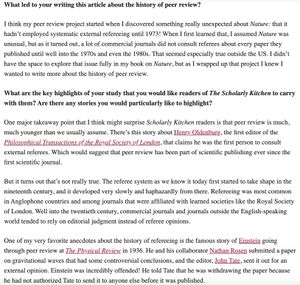
So, please, lecture me on Peer Review and how it has always been here in science. Just perserverate that same thing over and over and over again. I'm here for you.
When your head is often filled with malware, at least take a moment to figure out how much you want to teach someone else "with receipts" who isn't backing down.
Peer Review is a *RECENT*, unwanted, disastorous, administrative rewriting of research science culture. If you want to know what kills progress, it's this.
Source of image: Interview with Melinda Baldwin at the "Scholarly Kitchen".
People who lie about the research of others cannot be referees. Period. And that lying is absolutely everywhere.
This is why we stagnate.
If you put consensus scientists in charge, you always stagnate innovation. The consensus is VERY often wrong.
We had it more right before.
I call up MIT, and I call up David Kaiser. And I say, look, here's the history that I know. You know, we're not talking to people. I deal with colleagues who believe that peer review is is an intrinsic part of science, which is clearly not true. The brainwashing of our scientific institutions, that the fact that we don't know the history of the Golden Age of general relativity that we don't understand the way in which anti gravity intersected the way that we don't understand that we distributed programs in the interstitial regions between nonprofits like universities, government, agencies, like units of the military and private corporations, like our aerospace corporations. We used to know how things got done. And then we passed the Mansfield amendment in the late 1960s, early 1970s, to put the kibosh on military funding of civilian research. And we went completely insane. I mean, I understand their motivation for not wanting the military to be directing civilian research during the Vietnam War. But when you knock out a load bearing wall, you are responsible for putting some support in its place before the destruction is complete.
— Eric Weinstein, June 16, 2021, on Eric Weinstein & Michael Shermer: An honest dialogue about UFOs
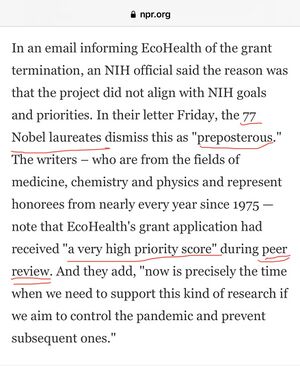
For those who still believe in peer review and scientific consensus, ask yourself why someone like the great particle theorist Steven Weinberg (1933-2021) understood Corona Virus GoF risk enough to issue such a strong statement in support of @EcoHealthNYC: 77 Nobel Laureates Express “Grave Concern” Over NIH Grant Cancellation
— Eric Weinstein, March 6, 2023, on X
The pressure for conformity is enormous. I have experienced it in editors’ rejection of submitted papers, based on venomous criticism of anonymous referees. The replacement of impartial reviewing by censorship will be the death of science.
— Julian Schwinger
Also, funding by peer review results in group-think and whole scientific fields floating off in a self-perpetuating irreality bubble for decades. Randomness will fund mavericks, mostly crackpots, but some may blow up established dysfunctional disciplines.
A technical argument by a trusted author, which is hard to check and looks similar to arguments known to be correct, is hardly ever checked in detail.
Research by salaried laborers is becoming a rent-seeking citation ring consisting of large scale imitative rituals, with a decreasing number of results, an increasing cluelessness of participants, and a multiplication of useless rules.
On Youtube
On X
2009
CLAIM: It is unethical to offer rent seekers anonymity w/ peer review if they refuse to risk profit 'shorting' what they block.
Q:Given that 'peer review' is objectively a major danger to innovators, why make it difficult-to-impossible to arbitrage? Cui bono?
2011
The anonymity differential in peer review has been exactly reversed from what makes sense.
Not to mention, obviously so.
2013
"I can’t figure out why my study of the pervasive denial of bias in academic peer review was rejected for publication." #paradoxofacademics
2016
If I wanted to destroy the scientific capability of an enemy nation, I would first get them to adopt accountability, metrics & peer review.
If you think about it, "Peer Review" is what potentially stops peers from reviewing your work. It's really Expert Suppression. Oh, language.
2018
1/ APRIL FOOL'S SCIENCE: A proposal.
Already bored of the coming "April Fools' Day!" pranks? Same here. And it's still March!
Consider how we might re-purpose this resource for science. What if 1 day a year, we explored big ideas that'd normally result in professional shunning?
2/ In years past, you might have seen a post suggesting that stress doesn't cause ulcers. That fear of being labeled a Lamarkian was keeping us from seeing epigenetics properly. That carbs in the food pyramid were wildly off. That laboratory mice were engineered to approve drugs.
3/ My belief is that most great scientific ideas are likely dying w their creators because the cost of destroying the livelihood & reputation of any rival entertaining threatening ideas is so low, while the ability to do so has never been easier since peer review entered science.
4/ In particular, I think our young people need to not have to wait for the retirement of elders to advance new ideas. How many young people in Physics ask "Why is David Gross setting the direction yet again? Should we *try* giving the closing/opening talk to someone under 25?"
5/ What is moving me today, is a letter from Einstein to his friend Habicht in the fall of 1905. In it he opens up about a lack of complete confidence because the good lord may be playing a trick on him. And this during his "Miracle year"! So April 1st is the day to call g-d out.
6/ To put it in Einstein's terms "I cannot tell whether the good lord is playing a trick on me" but he seems to be telling me that perhaps it's really established scientists, science administrators, and research institutions who are holding back colleagues w/ better bolder ideas.
7/ So on April 1, let any junior faculty, adjunct, research assistant, student, outsider, or even Nobel Laureate who is foolhardy enough to come forward with disruptive dangerous unlikely but *competent* partial ideas do so without fear. Then let them develop those ideas for 1Yr.
END/ At the end of a year, let the fools report back. They can choose to abandon the idea without reputational cost, or pursue it letting the skeptics, the hard-asses, and the luminaries engage in their usual dominance displays & policing activities.
Thank you for your time.
2020
I wouldn’t worry. My friends assure me this will all be caught easily in Peer Review before publication.
What stage are these drafts in *before* release?

I am ringing the alarm. We have now found >400 papers that all share a very similar title layout, graph layout, and (most importantly) the same Western blot layout. This is a massive #PaperMill of (what we assume) fabricated data.
Wait...what? But that’s impossible!
It is extremely disturbing that most of these 400 papers have passed #PeerReview. The Western blot figures look too regular and have the same background. None of the 800+ peer reviewers or editors asked critical questions about such figures. Don't be that peer reviewer.
So ... Forgive me. Wouldn’t that call Peer Review into question then?
Thanks for this! In essence the article says that Peer Review isn’t even Peer Reviewable because we haven’t been able to get good data. Yet it has 98% support of researchers with nearly zero data and an incorrect first sentence in the premier science journal, Nature. #ResIpsaBaby

Peer review under—peer review
Calling @EricRWeinstein @BretWeinstein shining light on “DISC” distributed idea suppression complex
Scientists study phenomena to REVEAL them—we ought study scientists to REVEAL phenomena of scientists who SUPPRESS (& why) https://nature.com/articles/d41586-020-00500-y
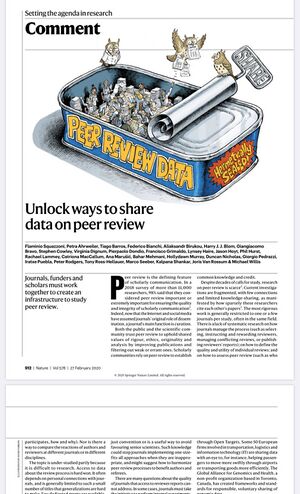
The first clue is “98% said they considered peer review important or extremely important”.
Ahem. 98% is the kind of numbers dictators put up in sham elections.
Study the history here. This is the journal that wouldn’t Peer Review the Double Helix.
This mob is perfectly wrong.
2021
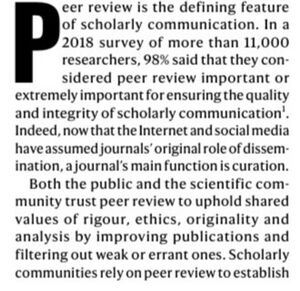
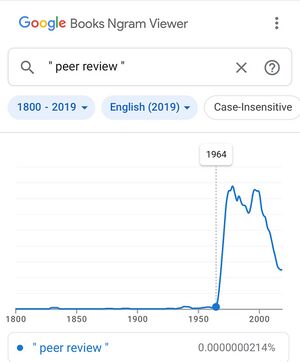
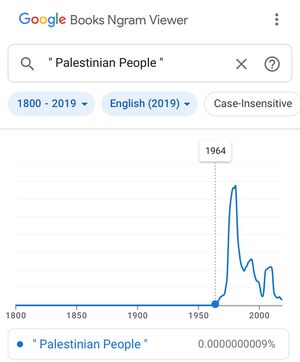
Google’s Ngram viewer is an astounding tool for figuring out how much your own mind is fully brainwashed by respectable voices and institutions.
No one was talking about “refereed journals” before the mid 1960s. This is a fad that doesn’t work. Unless your last name is Maxwell.
“Why don’t people trust science, scientists, peer review and data like they used to do in earlier eras as our most reliable source of ground truth? We’re in a life and death pandemic after all!”
I don’t know. Let me think about that.

Our new issue is here! On the cover—'Periods on display' and the cultural movement against menstrual shame and #PeriodPoverty.
Plus, @WHO air quality guidelines, low #BackPain management, community-acquired bacterial #meningitis, and more. Read: http://hubs.li/H0Y33_L0
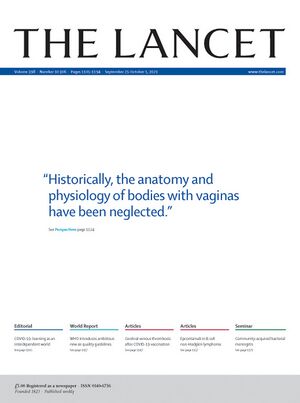
It might not be a problem if trust were high.
If you STILL feel that the WHO is a simple health organization, @EcoHealthNYC is merely an ecological charity, peer review works in gain of function, etc., you aren’t bothered by much of ANYTHING.
It’s the rest of us I’m addressing.

How is using a photo setup in any way significant to the topic? Or are you claiming that the booster shot wasn't real? Or are you just being meta-ironic?
I’m making the point that trust is *THE* issue. Many of the unvaccinated have taken vaccines their whole lives. For those folks, this is the first Vaccine they don’t trust. Think about that. We are labeling people crackpots and anti-vaxxers who have been multiply vaccinated.
If trust is the issue, don’t fake a backdrop with phony windows. Use a curtain. Use a panel. Use a photo op in a garden. But don’t fake anything. It breaks trust. You have to Build it instead.
No part of this is difficult to understand if you want buy-in.
Have a great weekend.
I have been warning you about Peer Review. Because almost no one says this, it sounds crazy.
Dr Daszak & @EcoHealthNYC have been thoroughly Peer Reviewed and are endorsed by the highest levels of scientists. It’s ‘preposterous’ to question a decision to terminate their funding.
2022
2023
2024
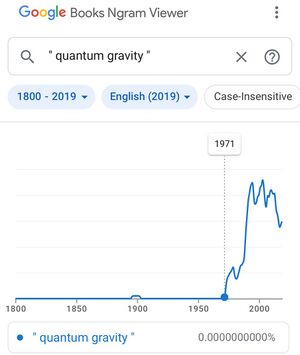
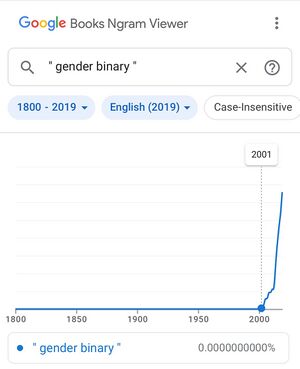
PREDICTION: Google Ngram Viewer will be shut down one day for public access. It is simply too subversive.
GNV is one of the most powerful remaining tools we have in the daily war against the abuses of the Gated Institutional Narrative or GIN.
2025
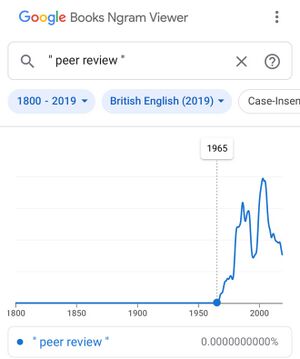
Your reminder that *all* science before 1965 was not “Peer Reviewed “ and hence is totally unreliable. Allegedly.
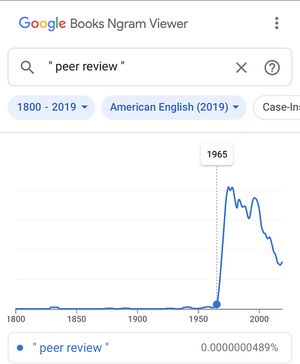
Medical Peer Review starts then because of the passage of the Social Security Amendments of 1965 establishing Medicare. Scientific Peer Review comes out of Robert Maxwell, Pergamon Press and ultimately the Baumann Amendment a decade later responding to “Man, a Course of Study.”
Q: Why do I not back down when experts tell me I'm an idiot?
A: Mobs of credentialed experts are OFTEN just *TOTALLY* wrong in their very area of exerptise. They tend to reinforce each other in their certainties.
In particular, *SCIENTISTS ARE FLAT OUT WRONG* on "Peer Review":
So, please, lecture me on Peer Review and how it has always been here in science. Just perserverate that same thing over and over and over again. I'm here for you.
When your head is often filled with malware, at least take a moment to figure out how much you want to teach someone else "with receipts" who isn't backing down.
Peer Review is a *RECENT*, unwanted, disastorous, administrative rewriting of research science culture. If you want to know what kills progress, it's this.
Source of image: Interview with Melinda Baldwin at the "Scholarly Kitchen".
People who lie about the research of others cannot be referees. Period. And that lying is absolutely everywhere.
This is why we stagnate.
If you put consensus scientists in charge, you always stagnate innovation. The consensus is VERY often wrong.
We had it more right before.
Our institutions are often lying about science. And *they* are the ones saying “We cannot allow public questioning of our institutions of science by PhDs.”
And if you don’t believe me, start with the lie about Peer Review and Journals.
We are literally lying about Peer Review:

Peer Review is a recent unwanted development in Science.
The lie is that it is bedrock science and dates back to the founding of the Royal Society. I’ve covered this extensively.
Ask yourself the following.
Q1: Would you rather have the science and scientists from before the advent of Peer Review during 1965-75, or after?
Q2: Do you trust scientists more or less if they claim that Peer Review is essential, and dates to the founding of the Royal Society?

@EricRWeinstein It’s amazing that peer review is such a recent development. Prior to reading your comments on it, I had just assumed it was a longstanding tradition in the sciences.
Science obviously worked fine before peer review, and it may just drive groupthink more than anything else.
Editors who are distinguished fiercely independent researchers themselves, with huevos of steel, integrity, a cuture of collegiality, autonomy, money, and a variety of strong differing opinions.

Relevant Essays and Papers