
Price Statistics Review Committee (Stigler Commission): Difference between revisions
(→On X) |
|||
| (One intermediate revision by the same user not shown) | |||
| Line 50: | Line 50: | ||
The commission's legacy extended beyond the U.S., influencing international price index standards, and it set a precedent for later reviews like the Boskin Commission (1996) and the National Research Council (2002), which built on its COLI advocacy while addressing remaining biases. Despite political sensitivities—e.g., labor unions' concerns over downward adjustments—the changes enhanced the CPI's economic rigor, though debates persist on whether it fully captures subgroup differences or modern issues like medical care costs. | The commission's legacy extended beyond the U.S., influencing international price index standards, and it set a precedent for later reviews like the Boskin Commission (1996) and the National Research Council (2002), which built on its COLI advocacy while addressing remaining biases. Despite political sensitivities—e.g., labor unions' concerns over downward adjustments—the changes enhanced the CPI's economic rigor, though debates persist on whether it fully captures subgroup differences or modern issues like medical care costs. | ||
== On X == | |||
{{Tweet | |||
|image=Eric profile picture.jpg | |||
|nameurl=https://x.com/EricRWeinstein/status/1990534949397803328 | |||
|name=Eric Weinstein | |||
|usernameurl=https://x.com/EricRWeinstein | |||
|username=EricRWeinstein | |||
|content=So to sum it up: he is not wrong. | |||
I think what I said to him is that after the 1950s, inflation became a modern tool/weapon rather than a measurement starting with the Stigler Commisson. I explained my view that the @BLS_gov is a quiet version of the @federalreserve. An insanely powerful “Statistics” organization where economists actually implement policy by simply chosing how to compute economic numbers. | |||
Numbers that just so happen to automatically transfer trillions and touch every aspect of our lives. | |||
He already knew a lot of the [[Boskin Commission|Boskin]]/GaugeTheory story from Harvard. Less about [[George Stigler|Stigler]] if I remember correctly. | |||
I’d love to ask Larry about all this now. | |||
|thread= | |||
{{Tweet | |||
|image=Eric profile picture.jpg | |||
|nameurl=https://x.com/EricRWeinstein/status/1990530011191992536 | |||
|name=Eric Weinstein | |||
|usernameurl=https://x.com/EricRWeinstein | |||
|username=EricRWeinstein | |||
|content=I believe [[Jeffrey Epstein|Epstein]] is referring implicitly to the “Stigler Commission” of 1959-1961. | |||
This comes from a phone conversation around 2004. | |||
|quote= | |||
{{Tweet | |||
|image=nkulw-profile-gpcdbDoT.jpg | |||
|nameurl=https://x.com/nkulw/status/1988837873513033941 | |||
|name=noah kulwin | |||
|usernameurl=https://x.com/nkulw | |||
|username=nkulw | |||
|content=“inflation is a concept from the 50s” what did he mean… | |||
|media1=nkulw-X-post-1988837873513033941-G5nFgW9XsAAL4lW.jpg | |||
|timestamp=5:14 AM · Nov 12, 2025 | |||
}} | |||
|timestamp=9:18 PM · Nov 17, 2025 | |||
}} | |||
{{Tweet | |||
|image=Eric profile picture.jpg | |||
|nameurl=https://x.com/EricRWeinstein/status/1990530014107107416 | |||
|name=Eric Weinstein | |||
|usernameurl=https://x.com/EricRWeinstein | |||
|username=EricRWeinstein | |||
|content=In a telephone conversation around 2004, he somehow was already well aware of the [[Boskin Commission|1996 Boskin Commission]] and Harvard Economics department burying our work on [[Gauge Theory]] in economics called “[[Geometric Marginalism]]”. That seemed pretty weird at the time. | |||
With the benefit of hindsight and scrutiny, I now understand that he was connected to AT LEAST two of my colleagues from my time as an Economist in the @HarvardEcon department and @nber. To say nothing of the fact that he was connected to AT LEAST two more of colleagues from my time as an math graduate student in the @HarvardMath department. He was evidently in the background of *everywhere* I was over three and a half decades from 1985-2019. It’s astounding. | |||
I believe from memory what he means is the following: | |||
In the 1950s inflation was not yet the tool of policy that it became after the [[Price Statistics Review Committee (Stigler Commission)|“Price Statistics Review Committee”]] around 1960, and the indexing of Social Security to [[CPI]] in the mid 1970s. It was a simple gauge. | |||
After that time, it became a quiet tool. And a weapon. You could use it to transfer not billions…but trillions. Why? Because a GIANT amount of all U.S. Federal receipts are indexed. | |||
He thought it was funny that we expected our work to be heard given that trillions were being stolen. | |||
I hope that there is a transcript of this conversation as well as the gravity phone calls about [[Theory of Geometric Unity|GU]]. If so, it will likely point back to Litauer and Rosovsky, Jorgenson and Summers. | |||
|timestamp=9:18 PM · Nov 17, 2025 | |||
}} | |||
|timestamp=9:38 PM · Nov 17, 2025 | |||
}} | |||
== Related Pages == | == Related Pages == | ||
Latest revision as of 01:43, 30 November 2025

The Stigler Commission, officially known as the Price Statistics Review Committee, was a pivotal body established in 1959 by the National Bureau of Economic Research (NBER) at the request of the U.S. Bureau of the Budget (predecessor to the Office of Management and Budget). It was chaired by economist George Stigler, who later won the Nobel Prize in Economics in 1982 for his work on industrial organization and regulation. The committee's primary objective was to conduct a comprehensive review of federal government price statistics, including the Consumer Price Index (CPI), Wholesale Price Index (WPI, now Producer Price Index), and other measures of inflation. This review was prompted by congressional hearings in the late 1950s, particularly those by the Joint Economic Committee, which highlighted concerns over the accuracy and conceptual foundations of these indices amid postwar economic changes, such as shifting consumer behaviors and quality improvements in goods.
The committee consisted of prominent economists and statisticians, including Stigler as chair, along with members like Zvi Griliches (who contributed a key staff paper on hedonic pricing), and others from academia and government. It produced a main report titled The Price Statistics of the Federal Government, published in 1961, accompanied by 12 staff papers that delved into specific technical issues. The report was transmitted to Congress and influenced subsequent BLS practices, though implementation was gradual due to initial resistance from the Bureau of Labor Statistics (BLS).
Key Findings on CPI Methodology and Biases[edit]
The Stigler Commission critically examined the CPI, which at the time was essentially a fixed-weight Laspeyres index measuring changes in the cost of a predetermined "market basket" of goods and services. The committee found this approach inadequate for capturing true changes in the cost of living, as it did not align with how consumers actually behaved in response to price changes. Key biases identified included:
- Substitution Bias: Consumers naturally substitute toward cheaper alternatives when prices rise, but the fixed-basket method ignored this, leading to an overstatement of inflation. The committee noted this was particularly evident during wartime shortages (e.g., World War II and the Korean War), where "forced uptrading" to higher-priced items distorted measurements.
- Quality Change Bias: Improvements or deteriorations in product quality were often not accounted for, resulting in either over- or underestimation of price changes. For instance, if a product's quality improved while its price stayed the same, the index might fail to reflect the effective price decrease in terms of value received.
- New Products Bias: The delayed inclusion of new goods (e.g., emerging technologies) meant the index missed welfare gains from falling prices and increased consumption of these items over time.
- Durable Goods and Homeownership Bias: The CPI treated homeownership costs via an "asset-price" approach, focusing on purchase prices and mortgage interest, which overstated inflation by conflating investment with consumption. The committee argued this ignored the "flow-of-services" consumers actually derive from durables like housing.
Unlike the later Boskin Commission (1996), which quantified an overall CPI overstatement of about 1.1 percentage points per year, the Stigler Committee avoided precise numerical estimates due to data limitations. However, it emphasized that these conceptual flaws made the CPI unsuitable for its growing uses in wage negotiations, contracts, and government indexing.
Recommendations for Improvements[edit]
The committee's core recommendation was to reorient the CPI from a Cost of Goods Index (COGI, fixed basket) to a Cost-of-Living Index (COLI) framework, grounded in utility theory. This would measure the minimum expenditure needed to maintain a constant level of welfare or utility, rather than pricing a static set of items. Specific suggestions included:
- Adopt COLI Principles: Use economic theory to incorporate consumer substitutions, with tools like Paasche indexes to bound overstatements from the Laspeyres formula. This would make the CPI a "constant-utility" index better suited for its practical applications.
- Hedonic Methods for Quality Adjustments**: Endorse hedonic regression techniques to quantify and adjust for quality changes, as demonstrated in Griliches' staff paper on automobile pricing. This involves breaking down price changes into components attributable to observable characteristics (e.g., engine power, safety features).
- Probability Sampling: Shift from judgmental to probability-based sampling for outlets, varieties, and items to ensure representativeness, reduce manipulation risks, and allow variance estimation. This included sales-weighted adjustments for new goods.
- Homeownership Measurement: Replace the asset-price method with a "rental equivalence" approach, estimating the cost of housing services (e.g., imputed rent for owner-occupied homes) to focus on consumption rather than investment.
- Frequent Updates: Update basket weights more often to reflect changing consumption patterns, and establish a dedicated BLS research division for ongoing improvements.
The BLS initially resisted some changes, with Commissioner Ewan Clague arguing in 1961 hearings that a full COLI was unattainable due to subjectivity. However, the recommendations spurred action, including the creation of a BLS price research division.
Long-Term Impact on Inflation Measurement and Policy[edit]
The Stigler Commission's work had enduring effects on U.S. inflation measurement:
| Aspect | Pre-Stigler (Pre-1961) | Post-Stigler Influence |
|---|---|---|
| Conceptual Framework | Fixed-basket COGI, focused on goods prices. | Shift toward COLI, emphasizing utility and welfare; influenced BLS's 1978 revision and later Chained CPI (introduced 2002). |
| Sampling Methods | Judgmental, prone to bias. | Probability sampling adopted in 1964 (outlets) and fully in 1978, improving accuracy and credibility. |
| Quality Adjustments | Limited, ad hoc. | Hedonic methods trialed in 1978, expanded in 1990s (e.g., for computers, apparel). |
| Homeownership | Asset-price (purchase and interest). | Rental equivalence implemented in 1983, reducing upward bias. |
| Bias Mitigation | Ignored substitutions and new goods. | Gradual reductions in overstatement; paved way for Boskin Commission's 1.1% bias estimate and chained indexes. |
Policy-wise, the shift to COLI principles transformed the CPI from a neutral measurement tool into a subtle policy lever. By better accounting for substitutions and quality, the index tended to report lower inflation rates than a strict fixed-basket approach, which directly affected escalation clauses in contracts, wage adjustments, and federal programs. For example, Social Security benefits, military pensions, and parts of the income tax code are indexed to the CPI; lower measured inflation means smaller cost-of-living adjustments (COLAs), potentially saving the government billions annually in outlays while effectively transferring resources from beneficiaries to taxpayers. This aligns with the notion in Eric Weinstein's account of Jeffrey Epstein viewing the commission's refinements as turning inflation measurement into a "policy weapon," enabling trillions in fiscal transfers through understated COLAs over decades.
The commission's legacy extended beyond the U.S., influencing international price index standards, and it set a precedent for later reviews like the Boskin Commission (1996) and the National Research Council (2002), which built on its COLI advocacy while addressing remaining biases. Despite political sensitivities—e.g., labor unions' concerns over downward adjustments—the changes enhanced the CPI's economic rigor, though debates persist on whether it fully captures subgroup differences or modern issues like medical care costs.
On X[edit]

I believe Epstein is referring implicitly to the “Stigler Commission” of 1959-1961.
This comes from a phone conversation around 2004.

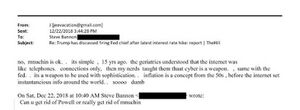
In a telephone conversation around 2004, he somehow was already well aware of the 1996 Boskin Commission and Harvard Economics department burying our work on Gauge Theory in economics called “Geometric Marginalism”. That seemed pretty weird at the time.
With the benefit of hindsight and scrutiny, I now understand that he was connected to AT LEAST two of my colleagues from my time as an Economist in the @HarvardEcon department and @nber. To say nothing of the fact that he was connected to AT LEAST two more of colleagues from my time as an math graduate student in the @HarvardMath department. He was evidently in the background of *everywhere* I was over three and a half decades from 1985-2019. It’s astounding.
I believe from memory what he means is the following:
In the 1950s inflation was not yet the tool of policy that it became after the “Price Statistics Review Committee” around 1960, and the indexing of Social Security to CPI in the mid 1970s. It was a simple gauge.
After that time, it became a quiet tool. And a weapon. You could use it to transfer not billions…but trillions. Why? Because a GIANT amount of all U.S. Federal receipts are indexed.
He thought it was funny that we expected our work to be heard given that trillions were being stolen.
I hope that there is a transcript of this conversation as well as the gravity phone calls about GU. If so, it will likely point back to Litauer and Rosovsky, Jorgenson and Summers.
So to sum it up: he is not wrong.
I think what I said to him is that after the 1950s, inflation became a modern tool/weapon rather than a measurement starting with the Stigler Commisson. I explained my view that the @BLS_gov is a quiet version of the @federalreserve. An insanely powerful “Statistics” organization where economists actually implement policy by simply chosing how to compute economic numbers.
Numbers that just so happen to automatically transfer trillions and touch every aspect of our lives.
He already knew a lot of the Boskin/GaugeTheory story from Harvard. Less about Stigler if I remember correctly.
I’d love to ask Larry about all this now.