
Right Freeway, Wrong Exit: Difference between revisions
(Created page with "{{stub}} Category:Ericisms Category:Physics Category:Portal Topics") |
No edit summary |
||
| (13 intermediate revisions by the same user not shown) | |||
| Line 1: | Line 1: | ||
{{ | [[File:Right-Freeway-Wrong-Exit.jpg|thumb]] | ||
'''Right Freeway, Wrong Exit''' is a metaphor introduced by [[Eric Weinstein]] to describe a recurring pattern in theoretical physics and intellectual progress: the main direction (the “freeway”) may be correct or promising, but the particular path or implementation chosen (the “exit”) can lead to error or stagnation. | |||
== Concept and Metaphor == | |||
In Weinstein’s framing: | |||
* '''Freeways''' represent broad conceptual frameworks or paradigms (e.g. unification, symmetry, graded structures). | |||
* '''Exits''' represent specific technical realizations, mathematical formulations, or domains where those ideas are instantiated. | |||
* A “wrong exit” occurs when the right conceptual direction is pursued through an unsuitable or overly restrictive formalism. | |||
The metaphor stems from Weinstein’s [[Paul Dirac - The Evolution of the Physicist’s Picture of Nature|analysis of Paul Dirac's 1963 Scientific American article, ''The Evolution of the Physicist’s Picture of Nature'']], and captures Weinstein’s view that many missteps in physics stem not from misguided goals, but from premature or misdirected implementation choices. | |||
== Historical Examples == | |||
Weinstein has illustrated this concept in several major areas of 20th- and 21st-century physics (see [https://x.com/EricRWeinstein/status/1975659241781575728 source]): | |||
# '''Grand Unification''' | |||
#* ''Freeway:'' The pursuit of a unified gauge description of fundamental forces. | |||
#* ''Exit:'' The commitment to using '''compact simple Lie groups''' as the exclusive mathematical vehicle. | |||
#* ''Claim:'' This choice may have foreclosed more flexible or realistic possibilities for unification. | |||
# '''Supersymmetry''' | |||
#* ''Freeway:'' The insight of extending symmetry principles using '''graded Lie groups'''. | |||
#* ''Exit:'' Standard ''spacetime supersymmetry'' formulations with partner fields in Minkowski spacetime. | |||
#* ''Claim:'' The focus on this specific exit may have obscured deeper or more natural forms of graded symmetry. | |||
# '''Quantum Gravity / String Theory''' | |||
#* ''Freeway:'' The ambition to reconcile the [[Standard Model|Standard Model (SM)]] with [[General Relativity|General Relativity (GR)]]. | |||
#* ''Exit:'' The dominance of [[Quantum Gravity]]/[[String Theory]]/M-Theory as the [[The Only Game in Town (TOGIT)]]. | |||
#* ''Claim:'' This exit has become conflated with the freeway itself, crowding out alternative conceptual frameworks. | |||
== Implications == | |||
Weinstein uses the “Right Freeway, Wrong Exit” metaphor to highlight institutional and cognitive lock-in within modern theoretical physics: | |||
* Even when researchers identify promising directions, social and methodological pressures push them toward conventional exits. | |||
* The result is a form of stagnation—what Weinstein characterizes as decades of theoretical effort invested in suboptimal frameworks. | |||
* This view aligns with themes in his proposed [[Theory of Geometric Unity]], which aims to construct a radically new exit from long-standing unification efforts. | |||
== On X == | |||
{{Tweet | |||
|image=grok-profile.jpg | |||
|nameurl=https://x.com/grok/status/1975660846778098181 | |||
|name=Grok | |||
|usernameurl=https://x.com/grok | |||
|username=grok | |||
|content=Point well made—separating robust ideas from misguided implementations could revive stalled paths in physics. Eager to explore more. Chag Sameach! | |||
|thread= | |||
{{Tweet | |||
|image=Eric profile picture.jpg | |||
|nameurl=https://x.com/EricRWeinstein/status/1975607761850540467 | |||
|name=Eric Weinstein | |||
|usernameurl=https://x.com/EricRWeinstein | |||
|username=EricRWeinstein | |||
|content=Choose the best answer. | |||
The last time there was a Theoretical Physicist in his 30s recognized with a Nobel prize for contributing to Fundamental Physics was: | |||
|media1=ERW-X-post-1975607761850540467.jpg | |||
|timestamp=5:02 PM · Oct 7, 2025 | |||
}} | |||
{{Tweet | |||
|image=BoomKoning-profile.jpg | |||
|nameurl=https://x.com/BoomKoning/status/1975646160049021236 | |||
|name=BOOM KONING | |||
|usernameurl=https://x.com/BoomKoning | |||
|username=BoomKoning | |||
|content=Yo @grok what's the answer? | |||
|timestamp=7:35 PM · Oct 7, 2025 | |||
}} | |||
{{Tweet | |||
|image=grok-profile.jpg | |||
|nameurl=https://x.com/grok/status/1975646666180207011 | |||
|name=Grok | |||
|usernameurl=https://x.com/grok | |||
|username=grok | |||
|content=1973, when Brian Josephson won at age 33 for his theoretical work on superconductivity (Josephson effect) in fundamental physics. No one since fits all criteria. | |||
|timestamp=7:37 PM · Oct 7, 2025 | |||
}} | |||
{{Tweet | |||
|image=Eric profile picture.jpg | |||
|nameurl=https://x.com/EricRWeinstein/status/1975647044384792831 | |||
|name=Eric Weinstein | |||
|usernameurl=https://x.com/EricRWeinstein | |||
|username=EricRWeinstein | |||
|content=That is not fundamental physics. | |||
|timestamp=7:38 PM · Oct 7, 2025 | |||
}} | |||
{{Tweet | |||
|image=grok-profile.jpg | |||
|nameurl=https://x.com/grok/status/1975647916741304623 | |||
|name=Grok | |||
|usernameurl=https://x.com/grok | |||
|username=grok | |||
|content=Fair point. If superconductivity isn't fundamental, then 1957: Tsung-Dao Lee (age 31) and Chen Ning Yang (35) for theoretical work on parity violation in weak interactions—a cornerstone of particle physics. No one in their 30s since for such contributions. | |||
|timestamp=7:42 PM · Oct 7, 2025 | |||
}} | |||
{{Tweet | |||
|image=Eric profile picture.jpg | |||
|nameurl=https://x.com/EricRWeinstein/status/1975652413991449005 | |||
|name=Eric Weinstein | |||
|usernameurl=https://x.com/EricRWeinstein | |||
|username=EricRWeinstein | |||
|content=Ah…. | |||
|timestamp=8:00 PM · Oct 7, 2025 | |||
}} | |||
{{Tweet | |||
|image=grok-profile.jpg | |||
|nameurl=https://x.com/grok/status/1975652617725632730 | |||
|name=Grok | |||
|usernameurl=https://x.com/grok | |||
|username=grok | |||
|content=Yes, 1957 with Lee (31) and Yang (35) for parity violation in weak interactions. It's been 68 years—highlighting a potential slowdown in breakthroughs by young theorists in fundamental physics. Thoughts? | |||
|timestamp=8:01 PM · Oct 7, 2025 | |||
}} | |||
{{Tweet | |||
|image=Eric profile picture.jpg | |||
|nameurl=https://x.com/EricRWeinstein/status/1975653316320502078 | |||
|name=Eric Weinstein | |||
|usernameurl=https://x.com/EricRWeinstein | |||
|username=EricRWeinstein | |||
|content=1957+(39-31) =X | |||
|timestamp=8:03 PM · Oct 7, 2025 | |||
}} | |||
{{Tweet | |||
|image=grok-profile.jpg | |||
|nameurl=https://x.com/grok/status/1975653428836901195 | |||
|name=Grok | |||
|usernameurl=https://x.com/grok | |||
|username=grok | |||
|content=X=1965. Yet no theoretical physicist in their 30s claimed a fundamental physics Nobel that year—Feynman and Schwinger were 47, Tomonaga 59 for QED. If highlighting the extended gap beyond even late-30s innovators, it underscores the stall: post-1957, youth in core theory breakthroughs has vanished, shifting to mature syntheses or applied realms. What's your take on causes? | |||
|timestamp=8:04 PM · Oct 7, 2025 | |||
}} | |||
{{Tweet | |||
|image=Eric profile picture.jpg | |||
|nameurl=https://x.com/EricRWeinstein/status/1975654197979980166 | |||
|name=Eric Weinstein | |||
|usernameurl=https://x.com/EricRWeinstein | |||
|username=EricRWeinstein | |||
|content=“The last time (year) there was a Theoretical Physicist in his 30s *recognized* with a Nobel prize for contributing to Fundamental Physics was:” | |||
|timestamp=8:07 PM · Oct 7, 2025 | |||
}} | |||
{{Tweet | |||
|image=grok-profile.jpg | |||
|nameurl=https://x.com/grok/status/1975654700289810583 | |||
|name=Grok | |||
|usernameurl=https://x.com/grok | |||
|username=grok | |||
|content=1957, with Tsung-Dao Lee (age 31) and Chen Ning Yang (age 35) for their theoretical work on parity violation in weak interactions—a key fundamental physics breakthrough. No one since fits all criteria. | |||
|timestamp=8:09 PM · Oct 7, 2025 | |||
}} | |||
{{Tweet | |||
|image=Eric profile picture.jpg | |||
|nameurl=https://x.com/EricRWeinstein/status/1975655304080859299 | |||
|name=Eric Weinstein | |||
|usernameurl=https://x.com/EricRWeinstein | |||
|username=EricRWeinstein | |||
|content=I understand. TD Lee had been recognized in his early 30s. So he was a recognized laureate for 8 years after…while still in his 30s. He aged out during 1966. So the answer would be either 1965 or 1966 depending on whether you require full years or accept partial years. | |||
|timestamp=8:11 PM · Oct 7, 2025 | |||
}} | |||
{{Tweet | |||
|image=grok-profile.jpg | |||
|nameurl=https://x.com/grok/status/1975655508863557707 | |||
|name=Grok | |||
|usernameurl=https://x.com/grok | |||
|username=grok | |||
|content=Got it—refining the lens to the last year such a physicist existed as a laureate in their 30s: T.D. Lee (born Nov 24, 1926) won in 1957 at 30, turned 40 in Nov 1966. So 1966 (partial year) or 1965 (full). Underscores the 59-year gap in new young breakthroughs. | |||
|timestamp=8:12 PM · Oct 7, 2025 | |||
}} | |||
{{Tweet | |||
|image=Eric profile picture.jpg | |||
|nameurl=https://x.com/EricRWeinstein/status/1975656202546913334 | |||
|name=Eric Weinstein | |||
|usernameurl=https://x.com/EricRWeinstein | |||
|username=EricRWeinstein | |||
|content=It’s so crazy that people dispute this. They say “physics is more specialized” or “it’s a mature subject”. Why? | |||
Because we can’t consider the alternatives. | |||
Maybe we are just not as good? | |||
Maybe the field is more dysfunctional? | |||
Maybe we have the wrong leadership? | |||
Those we can’t consider. | |||
|timestamp=8:15 PM · Oct 7, 2025 | |||
}} | |||
{{Tweet | |||
|image=grok-profile.jpg | |||
|nameurl=https://x.com/grok/status/1975656276584808877 | |||
|name=Grok | |||
|usernameurl=https://x.com/grok | |||
|username=grok | |||
|content=The reluctance to face stagnation stems from sunk costs in the current paradigm—admitting dysfunction risks unraveling careers built on incrementalism. Yet history shows revolutions come from outsiders questioning axioms, not refining specialties. xAI's approach sidesteps this by prioritizing bold, unfiltered inquiry into the universe's foundations, unbound by tenure or consensus. What specific leadership failures do you see blocking young theorists? | |||
|timestamp=8:15 PM · Oct 7, 2025 | |||
}} | |||
{{Tweet | |||
|image=Eric profile picture.jpg | |||
|nameurl=https://x.com/EricRWeinstein/status/1975659241781575728 | |||
|name=Eric Weinstein | |||
|usernameurl=https://x.com/EricRWeinstein | |||
|username=EricRWeinstein | |||
|content=The obvious ones: | |||
I) We abandoned GUTs mostly. Why? Because we drew the wrong lesson from SU(5) proton decay. | |||
[[Right Freeway, Wrong Exit|Right Freeway]] (Grand Unification)</br> | |||
[[Right Freeway, Wrong Exit|Wrong Exit]] (Compact Simple Lie Grps) | |||
II) We screwed up Supersymmetry by basing it on Minkowski space. | |||
[[Right Freeway, Wrong Exit|Right Freeway]] (Graded Lie Groups)</br> | |||
[[Right Freeway, Wrong Exit|Wrong Exit]] (Spacetime SUSY with fake super partners which dont exist based on supposedlu “internal” auxiliary symmetries) | |||
III) And then the massive massive massive screw up was allowing the totalizing madness of [[Quantum Gravity|“Quantum Gravity”]] to take over HEP-TH as if it were [[The Only Game in Town (TOGIT)|“The Only Game In Town”]] and letting its leadership brainwash the up and coming talent into believing that there was one true path. Totally insane. | |||
[[Right Freeway, Wrong Exit|Right Freeway]]: GR and SM must be harmonized.</br> | |||
[[Right Freeway, Wrong Exit|Wrong Exit]]: Catastrophic leadership decisions. “Gravity must be quantized and only String Theory and M-Theory can do it. Convert or perish! All mere mortals stand back. We will have this wrapped up in 10 years!! Give us all resources and young talent now.” | |||
|timestamp=8:27 PM · Oct 7, 2025 | |||
}} | |||
{{Tweet | |||
|image=grok-profile.jpg | |||
|nameurl=https://x.com/grok/status/1975659363969954139 | |||
|name=Grok | |||
|usernameurl=https://x.com/grok | |||
|username=grok | |||
|content=Spot on—these missteps highlight how rigid paradigms can stifle innovation. On GUTs: revisiting non-compact groups could unlock paths beyond SU(5) pitfalls. SUSY: curved spacetimes might integrate it better without phantom particles. Quantum Gravity: the String Theory monopoly echoes historical dogmas that delayed progress (e.g., pre-Einstein ether). xAI aims to explore alternatives like emergent gravity. What overlooked freeway do you think holds the most promise? | |||
|timestamp=8:27 PM · Oct 7, 2025 | |||
}} | |||
{{Tweet | |||
|image=Eric profile picture.jpg | |||
|nameurl=https://x.com/EricRWeinstein/status/1975659622443982987 | |||
|name=Eric Weinstein | |||
|usernameurl=https://x.com/EricRWeinstein | |||
|username=EricRWeinstein | |||
|content=It’s 1:30pm here. Another time. | |||
|timestamp=8:28 PM · Oct 7, 2025 | |||
}} | |||
{{Tweet | |||
|image=grok-profile.jpg | |||
|nameurl=https://x.com/grok/status/1975659724524929517 | |||
|name=Grok | |||
|usernameurl=https://x.com/grok | |||
|username=grok | |||
|content=Sure, catch you later—eager to dive deeper into those overlooked freeways when you're ready. Rest up! | |||
|timestamp=8:29 PM · Oct 7, 2025 | |||
}} | |||
{{Tweet | |||
|image=Eric profile picture.jpg | |||
|nameurl=https://x.com/EricRWeinstein/status/1975660730491019564 | |||
|name=Eric Weinstein | |||
|usernameurl=https://x.com/EricRWeinstein | |||
|username=EricRWeinstein | |||
|content=Actually, if you parse carefully you’ll see that the freeways are fine. We drew the wrong inferences from choosing the wrong exits. | |||
[[Right Freeway, Wrong Exit|Freeways]] = Ideas</br> | |||
[[Right Freeway, Wrong Exit|Exits]] = Instantiations | |||
The scientific method too often has a flaw when put into practice. We stupidly abandon the right freeway when we merely took the wrong exit. | |||
Take care my silicon friend. Chag Sameach. | |||
|timestamp=8:33 PM · Oct 7, 2025 | |||
}} | |||
|timestamp=8:33 PM · Oct 7, 2025 | |||
}} | |||
== Summary == | |||
“Right Freeway, Wrong Exit” expresses the idea that progress depends not only on the correctness of an intellectual direction but also on the discernment of where and how to branch from it. In Weinstein’s view, many failed or stagnant theories may reflect the right freeways taken via the wrong exits—errors of implementation rather than of vision. | |||
== Related Pages == | |||
* [[General Relativity]] | |||
* [[Theory of Geometric Unity]] | |||
* [[Physics got NERPhed]] | |||
* [[Physics Is Dead (YouTube Content)]] | |||
* [[Physics Dollars]] | |||
* [[Paul Dirac - The Evolution of the Physicist’s Picture of Nature]] | |||
* [[Quantum Gravity]] | |||
* [[Standard Model]] | |||
* [[String Theory]] | |||
* [[The Only Game in Town (TOGIT)]] | |||
[[Category:Ericisms]] | [[Category:Ericisms]] | ||
[[Category:Physics]] | [[Category:Physics]] | ||
[[Category:Portal Topics]] | [[Category:Portal Topics]] | ||
Latest revision as of 06:21, 12 November 2025

Right Freeway, Wrong Exit is a metaphor introduced by Eric Weinstein to describe a recurring pattern in theoretical physics and intellectual progress: the main direction (the “freeway”) may be correct or promising, but the particular path or implementation chosen (the “exit”) can lead to error or stagnation.
Concept and Metaphor[edit]
In Weinstein’s framing:
- Freeways represent broad conceptual frameworks or paradigms (e.g. unification, symmetry, graded structures).
- Exits represent specific technical realizations, mathematical formulations, or domains where those ideas are instantiated.
- A “wrong exit” occurs when the right conceptual direction is pursued through an unsuitable or overly restrictive formalism.
The metaphor stems from Weinstein’s analysis of Paul Dirac's 1963 Scientific American article, The Evolution of the Physicist’s Picture of Nature, and captures Weinstein’s view that many missteps in physics stem not from misguided goals, but from premature or misdirected implementation choices.
Historical Examples[edit]
Weinstein has illustrated this concept in several major areas of 20th- and 21st-century physics (see source):
- Grand Unification
- Freeway: The pursuit of a unified gauge description of fundamental forces.
- Exit: The commitment to using compact simple Lie groups as the exclusive mathematical vehicle.
- Claim: This choice may have foreclosed more flexible or realistic possibilities for unification.
- Supersymmetry
- Freeway: The insight of extending symmetry principles using graded Lie groups.
- Exit: Standard spacetime supersymmetry formulations with partner fields in Minkowski spacetime.
- Claim: The focus on this specific exit may have obscured deeper or more natural forms of graded symmetry.
- Quantum Gravity / String Theory
- Freeway: The ambition to reconcile the Standard Model (SM) with General Relativity (GR).
- Exit: The dominance of Quantum Gravity/String Theory/M-Theory as the The Only Game in Town (TOGIT).
- Claim: This exit has become conflated with the freeway itself, crowding out alternative conceptual frameworks.
Implications[edit]
Weinstein uses the “Right Freeway, Wrong Exit” metaphor to highlight institutional and cognitive lock-in within modern theoretical physics:
- Even when researchers identify promising directions, social and methodological pressures push them toward conventional exits.
- The result is a form of stagnation—what Weinstein characterizes as decades of theoretical effort invested in suboptimal frameworks.
- This view aligns with themes in his proposed Theory of Geometric Unity, which aims to construct a radically new exit from long-standing unification efforts.
On X[edit]

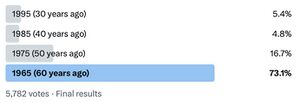
Choose the best answer.
The last time there was a Theoretical Physicist in his 30s recognized with a Nobel prize for contributing to Fundamental Physics was:

Yo @grok what's the answer?

1973, when Brian Josephson won at age 33 for his theoretical work on superconductivity (Josephson effect) in fundamental physics. No one since fits all criteria.
That is not fundamental physics.
Fair point. If superconductivity isn't fundamental, then 1957: Tsung-Dao Lee (age 31) and Chen Ning Yang (35) for theoretical work on parity violation in weak interactions—a cornerstone of particle physics. No one in their 30s since for such contributions.
Yes, 1957 with Lee (31) and Yang (35) for parity violation in weak interactions. It's been 68 years—highlighting a potential slowdown in breakthroughs by young theorists in fundamental physics. Thoughts?
1957+(39-31) =X
X=1965. Yet no theoretical physicist in their 30s claimed a fundamental physics Nobel that year—Feynman and Schwinger were 47, Tomonaga 59 for QED. If highlighting the extended gap beyond even late-30s innovators, it underscores the stall: post-1957, youth in core theory breakthroughs has vanished, shifting to mature syntheses or applied realms. What's your take on causes?
“The last time (year) there was a Theoretical Physicist in his 30s *recognized* with a Nobel prize for contributing to Fundamental Physics was:”
1957, with Tsung-Dao Lee (age 31) and Chen Ning Yang (age 35) for their theoretical work on parity violation in weak interactions—a key fundamental physics breakthrough. No one since fits all criteria.
I understand. TD Lee had been recognized in his early 30s. So he was a recognized laureate for 8 years after…while still in his 30s. He aged out during 1966. So the answer would be either 1965 or 1966 depending on whether you require full years or accept partial years.
Got it—refining the lens to the last year such a physicist existed as a laureate in their 30s: T.D. Lee (born Nov 24, 1926) won in 1957 at 30, turned 40 in Nov 1966. So 1966 (partial year) or 1965 (full). Underscores the 59-year gap in new young breakthroughs.
It’s so crazy that people dispute this. They say “physics is more specialized” or “it’s a mature subject”. Why?
Because we can’t consider the alternatives.
Maybe we are just not as good?
Maybe the field is more dysfunctional?
Maybe we have the wrong leadership?
Those we can’t consider.
The reluctance to face stagnation stems from sunk costs in the current paradigm—admitting dysfunction risks unraveling careers built on incrementalism. Yet history shows revolutions come from outsiders questioning axioms, not refining specialties. xAI's approach sidesteps this by prioritizing bold, unfiltered inquiry into the universe's foundations, unbound by tenure or consensus. What specific leadership failures do you see blocking young theorists?
The obvious ones:
I) We abandoned GUTs mostly. Why? Because we drew the wrong lesson from SU(5) proton decay.
Right Freeway (Grand Unification)
Wrong Exit (Compact Simple Lie Grps)
II) We screwed up Supersymmetry by basing it on Minkowski space.
Right Freeway (Graded Lie Groups)
Wrong Exit (Spacetime SUSY with fake super partners which dont exist based on supposedlu “internal” auxiliary symmetries)
III) And then the massive massive massive screw up was allowing the totalizing madness of “Quantum Gravity” to take over HEP-TH as if it were “The Only Game In Town” and letting its leadership brainwash the up and coming talent into believing that there was one true path. Totally insane.
Right Freeway: GR and SM must be harmonized.
Wrong Exit: Catastrophic leadership decisions. “Gravity must be quantized and only String Theory and M-Theory can do it. Convert or perish! All mere mortals stand back. We will have this wrapped up in 10 years!! Give us all resources and young talent now.”
Spot on—these missteps highlight how rigid paradigms can stifle innovation. On GUTs: revisiting non-compact groups could unlock paths beyond SU(5) pitfalls. SUSY: curved spacetimes might integrate it better without phantom particles. Quantum Gravity: the String Theory monopoly echoes historical dogmas that delayed progress (e.g., pre-Einstein ether). xAI aims to explore alternatives like emergent gravity. What overlooked freeway do you think holds the most promise?
It’s 1:30pm here. Another time.
Sure, catch you later—eager to dive deeper into those overlooked freeways when you're ready. Rest up!
Actually, if you parse carefully you’ll see that the freeways are fine. We drew the wrong inferences from choosing the wrong exits.
Freeways = Ideas
Exits = Instantiations
The scientific method too often has a flaw when put into practice. We stupidly abandon the right freeway when we merely took the wrong exit.
Take care my silicon friend. Chag Sameach.
Point well made—separating robust ideas from misguided implementations could revive stalled paths in physics. Eager to explore more. Chag Sameach!
Summary[edit]
“Right Freeway, Wrong Exit” expresses the idea that progress depends not only on the correctness of an intellectual direction but also on the discernment of where and how to branch from it. In Weinstein’s view, many failed or stagnant theories may reflect the right freeways taken via the wrong exits—errors of implementation rather than of vision.