
Academic Freedom: Difference between revisions
No edit summary |
No edit summary Tags: Mobile edit Mobile web edit |
||
| Line 1: | Line 1: | ||
'''Academic freedom''' refers not merely to the formal right of scholars to speak without punishment, but to a broader system of intellectual independence that enables genuine innovation, dissent, and cross-disciplinary thought. Eric Weinstein argues that while academia claims to protect freedom of inquiry, its institutional structures, funding mechanisms, and social norms have evolved towards systematic suppression of unconventional ideas and marginalization of independent thinkers. | '''Academic freedom''' refers not merely to the formal right of scholars to speak without punishment, but to a broader system of intellectual independence that enables genuine innovation, dissent, and cross-disciplinary thought. Eric Weinstein argues that while academia claims to protect freedom of inquiry, its institutional structures, funding mechanisms, and social norms have evolved towards systematic suppression of unconventional ideas and marginalization of independent thinkers. | ||
== Critique of Current Academia == | == Critique of Current Academia == | ||
Revision as of 07:44, 12 October 2025
Academic freedom refers not merely to the formal right of scholars to speak without punishment, but to a broader system of intellectual independence that enables genuine innovation, dissent, and cross-disciplinary thought. Eric Weinstein argues that while academia claims to protect freedom of inquiry, its institutional structures, funding mechanisms, and social norms have evolved towards systematic suppression of unconventional ideas and marginalization of independent thinkers.
Critique of Current Academia
- Stagnation and Narrative Control — Weinstein contends that academia has become “frozen,” producing only incremental progress within established paradigms. He links this to “gated narratives”—institutional storylines defining what counts as legitimate knowledge or progress (Feb 29, 2020). He argues that this extends to science journalism and public discourse, forming a coordinated ecosystem of idea control.
- Selective Enforcement and Retaliation — According to Weinstein, academic norms and disciplinary processes are enforced selectively to punish dissenters. His commentary on the 2017 Evergreen State College controversy—where his brother Bret Weinstein faced administrative pushback—is cited as a case study of institutional intolerance and risk aversion (Jun 1, 2017).
- Suppression of Economic and Policy Critiques — Weinstein claims that certain economic analyses, especially those addressing CPI, STEM wage manipulation and scientific funding policy, have been suppressed or ignored. He alleges that institutional studies on such topics were buried by major bodies like the NSF and NAS (Feb 29, 2020).
Prescriptive Proposals
- Structural Decentralization — Weinstein advocates for decentralizing knowledge production by creating independent research networks and alternative institutions that bypass legacy universities. This, he suggests, would restore freedom of inquiry by eliminating bureaucratic gatekeeping (Feb 29, 2020).
- Transparency and Accountability — He calls for greater transparency in how grants are awarded, how peer review is conducted, and how disciplinary measures are applied, to prevent covert ideological filtering (Nov 25, 2009).
- Protection for Heterodox Thinkers — Weinstein emphasizes that dissenters should be culturally and financially protected, arguing that universities must treat internal dissent as a vital driver of progress (Dec 1, 2009).
- Revaluation of Risk and Originality — He argues that science must reward originality and risk rather than penalize it. He connects this to the “decline of courage” in institutional decision-making and calls for redistributing resources toward exploratory, high-variance work (Dec 19, 2009).
Broader Context
Weinstein sees Academic Freedom as a civilizational issue: without the ability to question orthodoxy, societies lose the capacity for self-correction and innovation. He frames suppression of intellectual dissent as an existential threat to science, economics, and culture, warning that bureaucratic stagnation and distributed suppression lead to epistemic decay (Feb 29, 2020).
On X
2009

New Topic: "Thank you Science" vs. "You're welcome Science"
"let me just say to the funding agencies who have supported me thankyou, thankyou, thankyou!" -@dabacon. This is "Thank you science."
"Thank you Science" is a danger to all of us. Scientists like @dabacon likely need more freedom & acting like street musicians doesn't help.
Oddly, we don't need additional scientists to compete. We need our scientists stronger, richer, and more independent. Con huevos y dinero.
What is "You're welcome science"? It is a vision of science getting off its kness to remind the public of the fantastic deal it has w/ you.
"Dear Suzie Taxpayer: You're most welcome for the 2002 work warning of the coming danger posed by the misvaluation of illiquid assets." -ERW
The value that scientists could bring by debunking market thys alone could save the taxpayer billions upon billions. That's a lot of SSC's.
Bottom Line: If you need more salary, help in the house, security, and academic freedom, remember why we fund. It's *not* as favor to you.
Since basic research is a public good (i.e. inexhausible & inexcludible) markets will fail here: We need to know what you need to take risk.
Q: Cost(Collapse) >> Cost(Protected Dissenting Scientific Elite) ---> Cost(Cheap Academic Life) >> Cost(Expensive Academic Freedom)
How to avoid spending billions bailing out reckless bankers? Spend money on true academic freedom: the world's biggest bargain.
New Topic: "What's your vision of true academic freedom?" [Asks @Philip_Girvan.]
An old joke about the diference between the Soviet and US constitutions. Both give freedom to dissent. The US gives freedom the day after.
Academic freedom is about making secure heroes out of Margot O'toole, Doug Prasher & Nassim Taleb instead of pushing them to the periphery.
Academic freedom is freedom to invite a senior colleague to self-copulate for inserting himself before your name on YOUR paper..and survive.
Academic freedom comes from the academic *obligation* to schedule lectures if you have even the possibility of strong disruptive results.
Academic freedom entails a right for a non-expert theorist of high ability to cross boundaries and live on merit without seeking permission.
Academic freedom is the insulation from threat or want to continue in good standing for *any* and *all* contributions & reasoned dissent.
What few people admit is that opposing "String Theory", "The Great Moderation", "Scientist Shortages" etc...leads to excommunication.
This was best put by @BretWeinstein: "Selection is to be feared only when just individuals are prevented from returning costs."
So @ahaspel asks what institutional reforms are needed (which was where I was headed when a birthday party occured in physical reality).
First of all, I am focused primarily on science. If universities can't provide academic freedom, science needs to move homes.
Next: Basic research in science is a public good (inexhaustible and inexcludible). Therefore we need higher levels of public funding.
To maintain academic freedom we need to move resources from what is falsely called 'scientific training' to the compensation of researchers.
To get strong individuals, our target for researchers should be something like MA by 21-22 PhD by 25-26, permanent job by 26-28 (approx.).
Graduate training is actually much shorter than assumed. Typically one is a graduate 'student' in year 1,2 of a PhD and working thereafter.
Raising PhDs should be Eusocial. Giving students to PI's in a 1 on 1 relationship is like parking choir boys with priests. Better in theory.
We must also fund entirely different sorts of people. Without Huxleys, Grossmans, & Hardys you don't get Darwins, Einsteins, & Ramanujans.
A central point: scientists are supposed to be K-selected but universities are hell bent for leather to r-select PhDs.
Yet that's insane.
Research & Teaching in Universities are as perfectly linked as Skiing & Shooting in the Biathalon: tenuously for all but Professors / Finns.
Last point for now: Freedom for academics is precisely freedom from academics. A real marketplace of ideas beats the pants off peer review.
Something occurs to me. If you've never had reason to test your own academic freedom, you may have absolutely no idea what animated me.
On May 23, 2003 an extraordinary talk at NAS called “Exactly Backwards: Scientific Manpower Theory” was given.There is no record of this.
The talk was so extraordinary that it was repeated again at NAS 11 days later on June 3, 2003. Again there is no meaningful record of this.
The talk presented evidence to the National Academy of Sciences that NAS & @NSF partnered to manipulate markets over scientist salaries.
Now ask yourself why would @NSF be trying to weaken American scientists? Why would NAS help? How would NSF dependent scientists self-defend?
Gauge theoretic economics interest has come recently from @mathpunk @dabacon @diffeomacx @riemanmzeta @tylercowen @ahaspel etc... Loving it.
I should say that Gauge theoretic economics is also all about academic freedom, quashed as it was by the rennegade Boskin Commission idiocy.
An email from Twitter overnight said: "National Science Fdn (@NSF) is now following your tweets on Twitter." Yet, now @NSF is gone. But why?
As we can obviously see each other @NSF, I propose public dialogue on whether NSF should be strengthening scientists (ergo raising wages).
If you would like to see a dialogue with @NSF on academic freedom, compensation, shortage canards, etc... retweet and star.
An excellent test of our President is whether the Obama era @NSF can undo catastrophic damage to US scientists begun by the Reagan era NSF.
2010
How about Coasian markets in 'academic freedom'? Cap&Gown -> Cap&Trade? Or fractional ownership: Zip-Tenure! Anything but scientific silence
New Topic: Targeted killings of scientists & their families or "just what are you saving your academic freedom to protest?"
Let's skip the foreplay: nobody outside Iran wants to see a nuclear theocracy. Does that allow us to assassinate scientists & their kin? No.
As an American PhD I have every right & intention to strengthen & guide my country militarily..as do fellow scientists of hostile nations.
If N. Korea slips polonium into the sushi of a US Prof. for sharing her knowledge of elliptic curves w/ NSA cryptographers will you protest?
If you follow scientists on twitter, you will notice an absence of strong opinion on targeted killings of Iranian academic families.
Bottom line, if you lack the huevos to engage Iran at the state level, you have no right to target physicists, their wives & their children.
The father of Israel's Nuclear Program, Yuval Ne'eman eulogizes Abdus Salam, the father of Pakistan's http://bit.ly/fAMNda (from the Arabic)
2017
Proud of my brother, Biologist Prof. @BretWeinstein for standing up to racial divisiveness & for academic freedom. https://www.cooperpointjournal.com/2017/04/10/dl-on-the-faculty-dl-update-on-the-email-chain/
Within a university, the sound of silence is tenure without real academic freedom to speak our obvious truth. If you listen, it's deafening.
We're standing up to mob rule to fight for universal civil rights, academic freedom, science & free speech. Safety NOT guaranteed.
Want in?

Many have urged me to follow @jordanbpeterson's lead these last 2 weeks--friends, students, strangers. I'm listening https://www.patreon.com/bretweinstein
The Postmodernist threat to the sciences is now confirmed & fully capable of making work unsafe for professors requiring academic freedom.

Bret Weinstein and his wife Heather Heying just settled with Evergreen for $500,000 and resigned. Enrollment is... https://archive.kuow.org/news/2017-08-31/enrollment-drops-at-evergreen-state-college-hiring-freeze-coming
2020
This is the Distributed Idea Suppression Complex or DISC in action.
A hyper specific allegation that the @NSF and GUIRR inside the @theNASEM in 1986 directed an internal economic analysis to figure out how much they would have to pay STEM workers in the future.
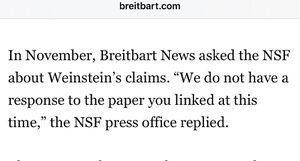
The study is economically competent using both supply & demand, and then found new US graduates would have to be paid 6 figures shortly. They termed this the “pessimistic scenario”, and then (and I‘m not making this up) faked an *incompetent* DEMOGRAPHIC study by removing demand!
The *competent* ECONOMIC study was protected and buried by never releasing it and removing the date and author from it. The author is still attached to NSF. To be clear: our @NSF is faking incompetence. The mainstream media is faking disinterest. Why? To not reveal the reasoning.
The reason we have sky high STEM immigration is wage tampering. The @NSF & @theNASEM undermined our own model of scientific independence, academic freedom & irreverent science that was the envy of the word by flooding US markets with pliable STEM labor. And over what? Just wages.
Now who is willing to get the @NSF on the record denial? Only the right leaning @BreitbartNews here! And US Instutional media treats anything that appears there as automatically beneath discussion. This is the logic of the Gated Institutional Narrative:
I don’t exist. Breitbart doesn’t exist. The secret study doesn’t have an author, a date or publication. All restrictionists are automatically racists. Blah blah..
But then why not call a liar @nsf? Why invite me to the National Academy 4 separate times to present this @theNASEM?
Ask yourself why your trusted media won’t put this story to rest. Just deny it @NSF. I triple-dirty-dog dare you. I would love the pleasure of having your spokespeople on The Portal to use your superior access to documents to explain.
Welcome to the DISC. Let’s do this thing.
When the story of the modern research university transformation is finally told, it will become clear that almost everyone with “academic freedom” refused to use it.
Almost isn’t everyone though. One of the only professors who spoke out: @matloff. A brave man. Follow him.
This is why we have academic freedom. It is wasted on almost all who have it. It is, however, essential for the *tiny* minority of people who use it.
In a polarized 🌎, I’m delighted to see a well respected Academic scientist like Prof. @DrBrianKeating w the courage to interview a prominent conservative Orthodox Jew after interviewing Radical Lefty atheist Prof Noam Chomsky.
If you believe in tolerance & free thought: listen.

UNCENSORED: @benshapiro. On Science Fiction, How to Destroy America in Three Easy Steps, & the one guest he most wants to interview! http://youtu.be/rQVf8gKwLHQ
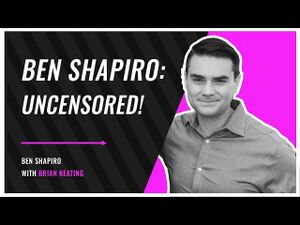
Brian is doing something bold given what academics in his world mostly believe. But what he‘s really doing is bringing perspectives together. I‘ve done two programs with him with guests I respect but with whom I disagree (@skdh, @stephen_wolfram). He’s bringing back what we lost.
If you believe in academic freedom, tolerance, free exchange of ideas, getting rid of academic siloing, and raising the level of the discourse, pay attention to Brian’s podcast. It’s still small compared to where it‘s headed. He’s getting great guests & great answers. #Subscribed
While Loops & Resource Leaks.
These mindless death spirals are found in nature. They have nothing to do with coding computers but are an ever present danger of filling the world with humans robbed of agency and the capacity to dissent from hive logic.
It’s difficult to explain to practical folks or Market and/or Democracy fundamentalists, that what you build into the rules will not necessarily remotely produce what you thought you‘d get. All coders/biologists, unlike politicians/voters, know this:
Neglecting political economy, capture of media/institutions, market failure, inequality, danger of critical theory, structural inequality, gerontocracy, academic freedom, scientific independence, etc as if these are negligible, dooms us to chase each other around an “ant mill”.
Moral: We appear to be caught in loops of our own creation. If so, conventional moves will continue to produce this cycling around the drain. It is time to consider more exotic moves to pull ourselves out.
We can no longer afford to fill the world w/ sheep, NPCs & followers. 🙏
I know of no 11 or now 12 figure billionaires endowing the independence of institutional sense-making.
In a highly unequal world widely agreed as having gone mad, securing Academic Freedom for Sense-making has now become of zero interest to anyone who has true financial freedom.
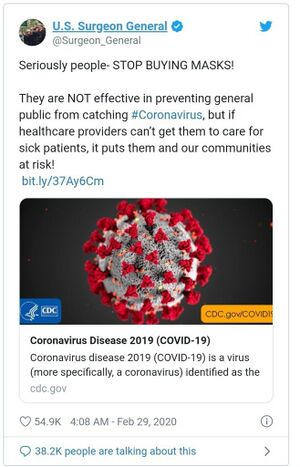
This claim about mask efficacy is disputed.
[By me, at a minimum, In March of 2020. Against Twitter policy of not contradicting health experts and risking my account.] https://x.com/Surgeon_Genera/Surgeon_General/status/1233725785283932160
Why are we pretending that our authorities are authorities? That our experts are experts? Why are we listening to @vijaya, @realDonaldTrump, @WHO, @Twitter, @DrAnthonyF, @SpeakerPelosi, @BilldeBlasio, @MayorOfLA, @GavinNewsom.
Who made people who can’t think straight, the elite?
Here is my question: why am I and others like me forced to worry about how @twitter, @vijaya, @Facebook, @sundarpichai, @Google, etc. feel when they get up in the morning? No one elected this class of overlords.
We need a tech form of “academic freedom” for who get things right.
I am watching people who have never both had and expressed a single correct independent thought in their life with their hands around the throat of everyone who has risked his/her reputation in public to get things right.
Why are these people our gatekeepers? This is madness. 🙏
Sir: Why do you have a job while I fear for the ability to remain employed and continue to have a social media account???? Who are you? Do you have magical qualifications? If so: what are they that allowed you to *directly* contradict your earlier equal confident pronouncement?

Say it with me, America: #COVIDStopsWithMe.
#COVID19
My explanation for Wokeness taking over our world:
Out institutions select specifically for hierarchical game playing and intrigue and against anyone who thinks from first principles and is willing to stand up for something she/he believes in to the point of self-sacrifice.
In essence the story of "Woke", "Critical Theory", etc... is really the story of the 50 years it took to clear out every last soul that understood the pivotal importance of "Academic Freedom" over "Quality Control", "Radical Inlusion", "Safety Culture", "Cancel Culture" etc.
What we have now is an institutional culture that is uniformly, to a leader, hostile to letting subject matter choose our experts and leaders for us and reward them with deep academic freedom and protection from targeted harrasment by administrators and the bureaucratic class.
At all turns we have muderous zealots eager to remove threats from within by pushing the 5 following ideas:
A) All research is collaborative.
B) Transparency trumps achievement.
C) Diversity trumps achievement.
D) EQ>IQ
E) All academic fields are equally scholarly.
All false.
2021
I have come to the conclusion that @jack needs to look at scientists who have been successfully threading the needles on this platform for a decade and give them academic freedom from the arbitrary application and selective enforcement of vague mercurial rules by @TwitterSafety.
Wow. The really bad guys are congratulating themselves for successfully conspiring and gaslighting against the even worse guys?
For America? Clearly I’ve lost this storyline...

Can @jack please restore the accounts of people who were saying this last summer and November and more recently? Thank you.
Actually, more generally, can we get a version of academic freedom on this platform @jack? Some of us take risks to speak against lying authorities. I’m sick of relitigating. One of the things that keeps even @TwitterSafety in check is folks who refuse authoritarian coordination.
Dear @jack:
I believe I must repeatedly violate @vijaya & @TwitterSafety rules to be honest about official lies. I believe you/they are also manipulating my reach. I call for an end to the opaque manipulation of the national conversation: we have a right to know your algorithms.
The SG DELETED the tweet I called out as a lie in real time. Here’s the lie the Surgeon General’s office covered up.
@jack: We can’t afford the responsible heterodox subjected to @TwitterSafety.
@nytimes: we can’t afford @TaylorLorenz & @nhannahjones enforcing your groupthink.
@jack, I am asking you as a friend and as a STEM PhD who has been responsible on your platform for over a decade to grant some heterodox tweeters academic freedom. Let some of be those who watch the watchers of your @TwitterSafety. We all need oversight of the oversight.
No one believes in your opaque Terms of Service. @TwitterSafety is artificially controlling our conversation determining who I can see & who I cannot.
Point Blank: You do *not* have the right to manipulate the US national conversation just because it takes place on your servers.
The few of you who will be able to see this thread at the beginning: please retweet the lead tweet. My reach is being controlled in ways I cannot understand. Many fewer of you are being shown these tweets than were previously. But they must always show this to a subset of you. 🙏
NOTE: I am noticing how I seldom see tweets from my friends with large followings the way I used to unless I visit their timelines. I’m noticing how much longer it now takes to grow a following on Twitter compared to other platforms. This is increasingly feeling like gaslighting:
Boğaziçi Univeristy has been the jewel of Turkey’s academic system since the Ottoman era.
But it is also associated with secularism, Christianity, tolerance, academic freedom, high standards and the west. And thus, it finds itself under attack from Turkey’s current government.

Boğaziçi U. academics are trying to have a court annul Erdoğan’s appointment of a politician as their rector. Meanwhile, the appointee is hurriedly stripping away BU’s core institutions. Faculty voting rights are gone. He himself will fill all positions.
Follow @timurkuran and your other Turkish academic friends. The government is going to try to destroy this counterweight to its power and has been very aggressive in its propaganda.
I’m pleased that @Spotify is not doing what @TwitterSafety and @YouTube are doing.
And way to go @joerogan. This informal network requires folks to have each other’s backs. But it’s always a risk with big tech, big pharma & big government on the side of these master narratives.
Huge thanks to @joerogan for the "emergency podcast" on #ivermectin, with me and @PierreKory. The censorship campaign obscuring Ivermectin (as prophylactic against SARS-CoV2 and as treatment for COVID-19) kills. Is it about shareholders and EUAs?
And a risk even to someone as large as Joe who has taken a lot of media fire with grace.
As I said to @esaagar & @makosloff, the money from Spotify may actually help freedom to think in public after all.
Oddly, at the moment:
Spotify FU Money > Institutional Academic Freedom.
Wait. Jeffrey Epstein was connected to the Intelligence Community?
Thank you @RollingStone!!! Can we finally get to the point where we are asking why THERE HAS BEEN TOTAL COOPERATION of the Press with what is likely a **TOTALY** UNETHICAL IC OPERATION?🙏
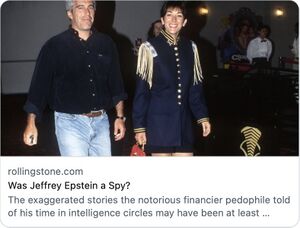
I want academic freedom on this platform @jack. It takes too long for the normies and the press to get to the truth. Your @TwitterSafety just isn’t good enough. This account was taking HUGE risk to talk about Epstein and intelligence.
Don’t ever think of throttling me again.
BTW, what matters here is that Rolling Stone is mainstream enough that they are unlikely to be fully ignored. As this account was when repeatedly bringing up Epstein as a construct of the IC…
Oh for f’s sake. Science didn’t lose the public trust.
Academicians stripped of academic freedom lost public trust. Irreproducible Peer reviewed papers lost public trust. Public health lost public trust.
Is ANYONE worried about Avogadro’s number or the genetic code being wrong?

You want to cure this problem we are having? Give scientists the freedom to form families with high participation in the very world science created, rather than asking them to peal you another grape while you take their work and humiliate them with truly *terrible* career paths.
Let them tell you to go F yourself when you subordinate them to a Fauci type politician in a lab coat.
When you ask for implicit bias testing to decolonize science, allow them to tell you that you are a quack racial fetishist. Let them kick you out of their buildings on campus.
Starkly: lap dogs & scientists are not the same thing. If you want to get a cuddle pal and put festive ribbons in its hair, you want a French poodle.
No one smart does that with a honey badger, wolf or Wolverine.
Scientists need insulation from you if you expect to trust them.
*peel
I’m watching our National suicide which I am powerless to stop or even slow for reasons that I simply cannot fathom.
Perhaps I’ve just outlived my time; I cannot recognize this world hell bent on madness and self harm to aid a communist superpower rival rising in the east. #NO

BREAKING: NYC to eliminate gifted + talented classes over the next 5 yrs, major change and likely BdB's last big decision as mayor. Kids now enrolled in gifted programs will stay in them, but there will be no more separate gifted classes for incoming kids https://www.nytimes.com/2021/10/08/nyregion/gifted-talented-nyc-schools.html
Any one of us ordinary Americans should just be able to say “Stop. Think. This is madness.” And get the Democrats to snap out of their trance like devotion to the destruction of the US.
But not one of us can make ANY real impact to slow this without institutions or resources.
Is there not one single US billionaire who wants to try to save the US research pipeline? One major tech CEO? Is there no research university President who wants to stand for academic freedom and our most talented students and future scientists?
How is there no one at all?
This was a functional nation until very recently. And the secret to our power and prosperity was largely about brainpower.
And we are getting to the point where gifts and talents are simply seen and portrayed as privilege and oppression to one of our two political parties.
I am totally lost by this.
Gonna have some more wine and a long think. I have no idea how to combat this level of stupidity. Nor does anyone else seemingly.
Shabbat Shalom to all. Have a great weekend.
Say that again. But louder. Not buried in a thread.
Let's be blunt: Science no longer needs money. It desperately needs FU money.
Years ago it didn't need FU money because its culture, tenure & institutional protection provided the FU of academic freedom. Now it *needs* wealth.

If labs can self fund it will change the landscape of science forever.
The genius of American Science in particular has historically come from a highly professional but irreverant belief in the individual iconoclast against the group. That culture, now found only in a few hold outs, is being hunted to extinction inside our radicalized Universities.
In the last year I was forced to give up my hope in our universities being reformed. We have to face facts.
It is far more important that our scientists gain enough wealth to self-fund, withstand law suits, be able to protect and support families, etc, than CEOs have 4th homes.
I have changed my mind. Wealth still works, while universities no lonnger do. Science has provided the technology on which our wealth is based. It is time that science and scientists shift to taking an enormous slice of the wealth and security they have provided to everyone else.
The United States public had a great deal. Scientists had the salary of professional with the freedom of a billionaire to think and express themselves. The US took away the right to IP in exchange.
Without real freedom provided by Tenure, we are forced to switch towards wealth.
If capitalism finds it abhorrent that scientists should participate in the wealth they created for every other wealthy person, then perhaps I was as wrong about the genius of Capitalism as I was about the genius of US Univ. in their defense of academic freedom.
But I hope not.
Would you prefer to send a promising STEM student to a university that was focused on Diversity Equity and Inclusion along with merit or one that was singularly focused on merit, ability, performance and academic freedom to the exclusion of nearly all other attributes:
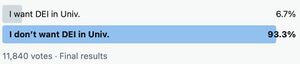
Things I don't believe we can't conclusively resolve:
A) COVID's origin.
B) The Jeffrey Epstein story.
C) UAP.
D) JFK assassination.
E) Vegas Shooting.
F) Extent of 'Democracy Fortifying' in 2020.
G) Efficacy of Non-Vaccines.
H) Mysterious WEF 'Build Back Better' mantra.
I) Negative impacts of Trade known to have been suppressed.
J) Adulteration of BLS CPI measure of inflation.
K) Negative economic impacts of Immigration.
L) Sudden spike in fake 'Objective Third Party Fact Checking'.
M) Sudden "Diversity Equity Inclusion" explosion.
Q) Joe Biden's state of cognitive decline.
R) Nature of MSNBC campagin against Andrew Yang.
S) Nature of Dean Scream, Anti-Ron Paul and other interference in democracy by Mainstream media News.
T) Impact of loss of mandatory retirement on young people seeking work.
U) Rex84.
V) Collusion between National Academy and National Science foundation division of Policy Research and Analysis to fake demographic crisis in mid 1980s.
W) Lack on anyone building the significant & desperately needed new non-profit institutions despite skyhigh wealth inequality.
X) Loss of Academic Freedom across the board in Academe.
Y) Loss of the Lancet and other publications as trusted non-political sources of fact.
Z) The true nature of @EcoHealthNYC w its relationship to @doddtra & Dr A. Fauci.
Moral: much of this 'ambiguity' is serving the few.
2022
I know of no well resourced individual interested in leading an attempt to save our institutions from current leadership. No one I know is studying why seemingly disjoint institutions (e.g. @splcenter, @ACLU, @nytimes, @UCBerkeley, @MSNBC, @NIH, @sciam, etc.) would act as one.
In short, anyone who could credibly even attempt to save these structures (or even allow us to understand their rapid collective demise by studying the slide without needing to seek funding or approval) is acting as if this isn't interesting or a priority...or they approve of it.
I don't know how to interpret this, but there are a very large number of folks without those levels of resources who have tried and paid dearly. Yet, I am aware of no mega check that has ever been written to allow them to know the freedom of dissent enjoyed by the ultrawealthy.
The entire idea of academic freedom was to free one class of people from "Sinclair's Prison". How do you make a scientist or an academician immunized from having her or his paycheck depend on whether she/he evidences understanding of an inconvenient truth power wants buried?
We don't have such people anymore. We need to get rid of modern "accountability" and all those other words that give people a gooey feeling they are doing the right thing. We need our truth apparatus immunized from the market as we had it before. Yet no one works on this issue.
Moral: markets may still be functioning, but wealth is not. The world of folks having their reputations systematically destroyed by trying to opennly call for defense of our institutions and their values against our current suicidal leadership & the on-line hordes is unsupported.
I'm not calling for support here. I am pointing out something much more interesting. No one wealthy...as in no one who owns a large private jet and above...finds this something worth doing. *ALL* of our wealthy have given up on our shared institutions. And I found that striking.
Maybe the wealthy are just super smart & have an escape plan. If so, I haven't heard it. Call it a hunch, but watching the collapse in institutional trust, I don't think this is going to end well for anyone, including the ultra wealthy. It's one planet connected by an atmosphere.
Organized civil disobedience is the correct next response to the prolonged, indefinite and deliberate abuse of exotic emergency powers inconsistent with being a free people in our own country.
I don’t want to go there, but it is time.
We are going to have to get CCP influence out of our country. We are going to have to get Fauci and Daszak to explain what we were doing in Wuhan. We are going to have to drive Pfizer out of news sponsorship. We are going to have to extend freedom of speech to digital speech.
We are going to need algorithmic transparency from Twitter through regulation. We are going to need to rein in the Feds ability to print its way into crushing the working class through seignorage and blowing out income inequality for holders of risk assets.
We are going to need to scale back our military obligations so we can actually be counted upon by our partners. We are going to need to prohibit the Whitehouse from attempting to label those who raise the president’s cognitive decline as “Purveyors of misinformation.”
We are going to need hearings on the intelligence community and it’s relationship to pedophiles like Jeff Epstein endangering our children. We are going to need the receipts and federal securities filings from his likely non-existent hedge fund. We need student debt forgiveness.
We are going to have to liberate our scientists with full academic freedom and wealth so they can level with us. We are going to have to push for what “Build back better” and “Great Reset” actually mean to the Stepford leaders who repeat it as mantra.
We’re going to have to release Twitter activists from the protections we established for journalists who obey the SPJ code of ethics in trying to report news as news rather than opinion… or worse. We are going to have to face this climate crisis without strongarming consensus.
We are going to need nearly FULL transparency on repeated hypersonic invasion of our military airspace by unknown actors with data given to physicists. We are going to need to know what quiet deal we had with the Taliban and ISI around the absurd Afghanistan pullout by US forces.
We are going to have to take back our research universities so that they can do research. We need to severely limit the number of administrators and adjunct/student workers and costly journals and debt financing for educations. We need student debt to be discharged in bankruptcy.
We’re going to need to stop CPI-U from being manipulated as a closet way of raising our taxes & slashing our benefits while pretending to simply calculate inflation. We need to review our trade agreements in light of revelations that they were always known to be Social Darwinist.
End
There are only so many times I can say it: you’ve asked science to make others wealthy, secure & free as you subjected scientists to a life of precariousness, peer review, groupthink, virtue signaling & bureaucracy.
The madness ends when you stop whining about PhDs w/ 2nd homes.
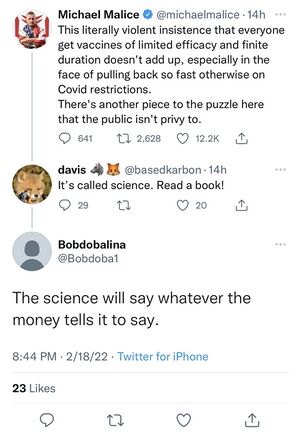
This is the reason you can’t get to the bottom of this virus. Where it came from. What is up with the CDC. The WHO. The @EcoHealthNYC. The mandates. The relative risk profile of vaccines.
You killed academic freedom & flooded their market. What did you expect exactly? Science?🤷♀️
Word to the wise: You do not want your scientists with fungible skills dependent on institutions/Fauci/Collins/NIH/NSF for their year to year ability to take care of their families.
This has been up for 20 years. You aren’t getting it:
https://ineteconomics.org/uploads/papers/Weinstein-GUI_NSF_SG_Complete_INET.pdf
Freedom of movement.
Freedom to hold property.
Freedom of speech.
Freedom of bodily self-determination.
Academic Freedom.
Freedom to information.
Freedom from Seigniorage.
Freedom of assembly.
Freedom to dissent.
Free and fair elections.
Q: How are we doing here?
Having been both in Academe and the private sector, I have learned something I cannot communicate:
A) The more you push science towards markets, the more it fails.
B) The more marketization makes science fail, the more capitalists want to starve it.
https://jacobin.com/2018/07/capitalism-science-research-academia-funding-publishing

Increasingly, the solution to every science problem is seen through markets.
X-prizes for science.
Science DAOs.
Crowdfunding for science.
Micro grants.
Science as a startup.
Anything *other* than recognizing our previous wisdom of insulating science & scientists from markets.
The answer to getting science to work again is a smaller scientific community with the ability to hold minority positions for decades if necessary.
Academic freedom was a lot less expensive when it was guaranteed by institutions. Now it requires FU money from which it’s starved.
Said differently, have we all quietly noticed that “The Science” isn’t science? Like not remotely science.
Let me say what the difference is:
In Science you have academic freedom to reject advances by politics. In “The Science”, you don’t eat if you don’t follow the narrative.
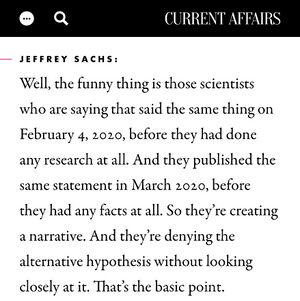
I want to end “The Science” to get back to “Science”, which means having comfortable and secure scientists who don’t worry about feeding & housing their kids when the wrong narratives need to be *directly* contradicted.
Can someone meme this with “Science” replacing “Butter”? 🙏
When the world is in its productive phase, it insulates top minds. It pays them to stay away from short term market incentives.
When the world is in its extractive phase, it subordinates top minds.
And you can read about this in my new book for $29.95!! Plus, if you act now...

But how do we do that. All our brightest minds seem obsessed on things of little consequence
Almost everyone is selling now. I respect the right to make a living. But it was a lot better before when we had the universities, civility, more functional government and above all *academic freedom*.
We’re not going to get those back from those doing the extraction however. 🙏
Willing to answer a few more Tweets on the San Marino UAP conference where I unexpectedly was asked to fill in for @LueElizondo. I’m likely to get throttled & harassed yet again. When and if the beloved Twitter nanny algorithm starts again, I’ll call it a night here in Rome.
Go!

Assuming there’s a “not from earth” element to this phenomenon, how would YOU approach the study of this in academia, somehow retaining some nationalistic viewpoint (be it military/energy) - aside from existential risk?
I’d start with academic freedom and civility. There is more than enough here to DEMAND answers. This belongs to science as much as it does to NatSec. We don’t need a Fauci for UAP. We need physics and math to begin. Biology if warranted. Let’s just be serious if it is a threat.
The gigglers & shamers & accusers need to get a pacifier and a juice box for a time out. We gave out too many PhDs to mediocre souls. It’s a disaster. It’s nuts that they’re STILL here to inhibit consideration of this after all the claims by USG.
Too much inclusion of trolls.
2023
Because:
Wuhan involves a Bio-Weapons Convention workaround using @EcoHealthNYC funded by @dtra.
CCP controls a huge market.
We created scientists who all fear for their ability to feed families when we ended true academic freedom.
It’s anti-interesting.
🙏

2024
For me, this has little to do w/ Kamala. It's:
Democracy vs TheDemocracy™
Science vs TheScience™
Privacy vs TheTermsOfServicePrivacyPolicy™
Free Speech vs OurFreeSpeech™
Academic Freedom vs USAcademicFreedom™
Diversity vs DEI™
Professional Agreement vs TheExpertConsensus™
I stopped at 240 Characters on this one, just so that it would all be displayed. Feel free to add your own kayfabrication examples. Many of us can finish each other’s thoughts at this point and would come up with the same basic lists:

Facts vs FactCheckers™
Truth vs TheNarrative™
Elite Achievement vs Elites™
References
- Eric Weinstein, X (Dec 19, 2009, 8:27 PM)
- Eric Weinstein, X (Dec 19, 2009, 8:31 PM)
- Eric Weinstein, X (Nov 25, 2009, 5:09 AM)
- Eric Weinstein, X (Dec 1, 2009, 2:33 PM)
- Eric Weinstein, X (Jun 1, 2017)
- Eric Weinstein, X (Feb 29, 2020)