
Ordinal Preferences
2009[edit]

Welfare as fiber bndle in 1tweet: Cardinal utlty under the group of reparametrizations of utils is a principal bndle over ordinal thy.
Intertemporal Welfare w/ Changing Ordinal Tastes in 1Tweet: Connections on the utlty bndle and consistent welfare thys are mapped 1-1.
Refutation of Fisher and Shell 1970 in 1Tweet: Prices -> distinguished choice connection on the utility bndle -> dynamic ordinal welfare.
$500 Challenge: Get me an invited Econ gig at Chicago / Harvard to confront the theory of ordinal welfare with stable homogenous tastes.
Ok @dabacon Beauty in Econ:
SpaceTime->OrdinalPrefs x Time
InternalSymm->Util Re-Params
GaugeFields->Indifference\Mkts
FieldStrength ...
Ok Paul: if you even had a perfect world, *define* inflation with evolving ordinal tastes O_t under prices p_t if O_t isn't fixed by Magic?
If @grahamfarmelo, in 10Y the representative consumer w/ seasonal ordinal tastes is modeled by a gauged quantum string, will Dirac be right?
2010[edit]
Seasonal tastes are periodic, ordinal utils are cardinal mod virosoro, rep.agents=distributions. Is a string/economic theory link nuts?Why?
2019[edit]
In the war between those who seek to weaponize reason, and those who seek to destroy it due to its having been weaponized, I’d prefer not to pick a side. They’re both vile.
But when I’ve absolutely had to choose? I can’t pick the latter: there’s no coming back from anti-reason.
@AnthemTrading Look at economic theory specially rigged to deliver pro business and pro finance results. The actual theory wouldn’t do that. It would be much more muted and even in what it says.
@Trentsickle @AnthemTrading Oh simple. For example you use cardinal utility theory in one sub field for issues of risk, but forbid it in another area like interpersonal comparisons where you shift to ordinal welfare. Otherwise cardinal welfare might lead to socialism given the law of diminishing returns.
2020[edit]
Oh. The ‘free’ part.
More generally the fundamentalist part: The “markets always know what’s best part”. The limited liability part. The self-regulating part. The unincorporated externality parts. The “given wants” part. The unique equilibrium part. The index number part.
The “market defects are small” part. The rational agent part. The shareholder value part. The “law & economics” part. The “hyperbolic discounting” part. The entire “Macroeconomics” part. The fiduciary duty cures principal/agent problems part. The Ordinal/cardinal part.
Etc. Etc.
@hotepsquake @Brian_Mulhall People get confused by a person who values markets but doesn’t buy into full free market fundamentalism.
Which is odd.
@gingernchronic @hotepsquake @Brian_Mulhall Well, I’m for limited versions of what the free market absolutists are for. They are right that markets are wonderful and that much regulation is hamfisted & subject to capture.
And then, to make that point, they go insane and claim markets are much more perfect than they are.
@gingernchronic @hotepsquake @Brian_Mulhall Most texts that sell economics 101 ideology to students have a “to be sure” section where they shunt the real issues with the theory. Consider taking that section as much more important than the author emphasizes it to be.
2021[edit]
Watch the US CPI revisions and methodology going forward. People who like to print money tend to want to change their definition of inflation and therefore don’t like anyone taking away freedom to make up methodologies to suit their political objectives involving wealth transfer.
If you’re going to push us all to move to “true” “economic” indices & chain them to reflect dynamic actors (or to disguise true inflation!), you would end up chaining ordinal preferences. And you can’t do that without gauge theory because it is a problem in parallel transport.
Economists are holding their own field back by retaining their freedom to just cook up any revised index they want.
It’s as if physicists retained the right to define temperature differently every year based on a closed door meeting and manufactured new thermometers thereafter.
The problem of inflation index calculation has not been adequately updated since Ragnar Frisch destroyed Irving Fisher’s attempt to axiomatize economic indices following the last great advances of F. Divisia and A. Konüs on continuous and welfare indices respectively.
Claim: when it comes to inflation and growth, Economists don’t even understand the theory of their *own* price and quantity indices mathematically:
Moral: whoever constructs CPI and GDP numbers in a dynamic economy is in a position to fake higher growth and lower inflation if they are also in a position to stop the field from debating methodological advances that would restrict the freedom to make up index number recipes. 🙏
We must take CPI away from those who wish to back out a political agenda of printing money, raising our taxes by indexed tax brackets and slashing our indexed social security & Medicare.
Economics can’t construct dynamic economic gauges like CPI/GDP until it learns gauge thy.
The economists can’t yet compute a dynamic Cost-Of-Living-Adjustment or COLA or “Chained Changing Preference Ordinal Welfare Konus Index” to be perfectly pedantic. Not because it doesn’t exist. But because they don’t have the math and don’t want to lose their finger on the scale.
CPI is broken. Why?
Think of CPI as a gauge like a thermometer. You can’t have politically motivated folks making your thermometers or they can change the design to cover up climate change. Likewise you can’t have economists changing the gauge to disguise the effect of printing.
CPI should not…MUST NOT…be adjustable to disguise inflation. It needs to be protected from the FED diluting the power of money and the BLS being free to disguise the effects by changing the method of construction.
No. Economics is a avoiding gauge theory, connections, Lie Groups, etc so it can retain its political relevance as an expert consultancy. I’m with the crypto folks on this. Our economy must be protected from Seigniorage (printing money) and CPI tampering (e.g. Boskin Commission).
It’s time to reveal that economics, far from embracing math or having physics envy, is deliberately avoiding solutions to old problems so that it can make up new gauges for CPI/GDP at will while telling the rest of the soft sciences “We know your field better because we do math.”
But more importantly, we have a culture that economics literally trumpets (and I swear I am not making this up) “Economic Imperialism”. It is “we know math and you don’t”-culture.
No. They don’t know their own math. I will debate any high ranking economist on this point.
P.S. before you remind me how arrogant this sounds, keep in mind, that I am willing to debate this publicly with any leading economist eager to defend the central bankers and triumphalist theorists openly bragging about their math. Read this, and be sick:
End the forced wealth transfers of central bankers covering up their own failures with “Relief”, “Easing”, “Stimulous”, “Rescues”, “Toxic Asset Purchases”, and other bailouts of our incompetent financial overlords.
We must protect CPI from economists disguising wealth dilution.
Moral: Gauge Theory fixes this intellectual corruption problem of economic imperialism, and #btc, blockchains and Crytpo can help.
Can just *one* of them compute a simple Cost-Of-Living CPI for a consumer whose notion of well-being evolves even *slightly* during any period in question?
I claim not. Let's not get carried away with this concept of economic experts. This field first needs to become healthy.
@engexplain I have and can.
@TheFenrirEffect @engexplain You are referring here to what is called a mechanical index. Not a true cost-of-living measure. No matter what BLS claims.
@ks_kulk @TheFenrirEffect @engexplain I don’t know of any other way to extend the Konus to time-varying ordinal tastes except through our construct. In fact I think you can prove it. As I recall you first prove any other extension is by a connection. Then you take the difference of the connections to get a 1-form.
@ks_kulk @TheFenrirEffect @engexplain Then the argument requires showing that no such non trivial Lie algebra valued form can be constructed without additional data beyond the tastes and prices given. So the difference 1-form must be 0.
Something like that. Akin to symmetry breaking. Additional data would be needed.
@ks_kulk @TheFenrirEffect @engexplain That is related. We discussed it with Lee back in the day.
@ks_kulk @TheFenrirEffect @engexplain Lee was very much influenced by his experience with things like “self-organized criticality” and other Santa Fe Institute type ideas. This wasn’t exactly that but there was an analogy up to a point.
ANNOUNCEMENT: I head next week to @UChicago for 5 days (Nov. 8-12) at the request of its storied Department of Economics to present our theory that all of economics is based on the wrong version of the differential calculus.
Importantly, this error afflicts Inflation & the CPI. https://t.co/YKaPHjpdtq
Please retweet the top tweet if you're followed by economists & others interested in the debate over inflation and CPI, and your followers would find a new geometric Marginal Revolution of interest. Thanks! cc: @tylercowen, @Breedlove22, @paulmromer, @PeterMcCormack, @EconTalker.
I am a huge believer in the University of Chicago and its ability to stay the course while all others bend to the prevailing winds.
As such, I may (or may not) be announcing other events to discuss other work (e.g. Geometric Unity) depending on time, interest & availability.🙏
Cc: @balajis, @HarvardEcon, @BLS_gov, @ethereum, @VitalikButerin, @paulkrugman, @MarcusduSautoy, @BitcoinMagazine, @brian_armstrong, @CoinDesk, @coinbase, @stevesaylor, @naval, @pmarca, @saylor, @Noahpinion, @UChicagoPhysics.
My understanding is that there will be a zoom link.
@curious_sausage @tylercowen @Breedlove22 @paulmromer @PeterMcCormack @EconTalker @ProfSteveKeen I never do! He’s great…and thanks for the reminder.
Cc:@nntaleb, @DrBrianKeating, @edfrenkel, @ProfSteveFuller, @ProfSteveKeen, @INETeconomics, @steve_tadelis, @JonHaidt, @bariweiss, @ggreenwald, @greggutfeld, @RHDijkgraaf, @SimonsFdn, @QuantaMagazine, @inferencereview, @BretWeinstein, @PiaMalaney, @fullydavid, @SamHarrisOrg.
@nuckynucker @UChicago I didn’t think it was closed. It’s an academic talk mind you, but most such talks are open.
@AgramSeth @nuckynucker @UChicago I am hearing that this event is not open. I, however, *am* open to doing an open event on the same material.
@_PeterRyan @UChicago Weird question. You seem to have me confused for the BLS. I don't take in Data. I don't have a staff or a budget. You're assuming that I have the 'Real Inflation & CPI numbers'. I don't.
This is about not even having a correct *theory* to calculate. What we corrected was theory.
@_PeterRyan @UChicago I didn’t say what you said. I said there was a wrong theory for CPI. We corrected that theory.
The issue of how to implement a theory in practice leases to different data being collected and different aggregations. For a different theory, you would collect different data.
@_PeterRyan @UChicago As an example. The Boskin commission gave a single illustrative example in their report using two goods, chicken and beef. They gave prices but not ordinal utility. Here is the COL answer assuming Cobb-Douglas and Linear interpolation of all quantities. They could not compute it. https://t.co/zUgd1LwBgx
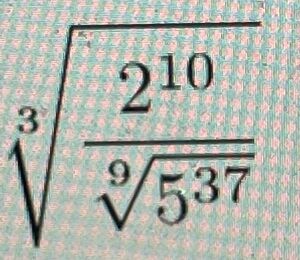
@_PeterRyan @UChicago The reason they had no theory to cover it was because the C-D exponent changed. And there is a claim that no extension of the Konus COL exists for dynamic tastes.
Hope that helps with your confusion. Be well.
@_PeterRyan @UChicago *leads not leases in the above.
@_PeterRyan @UChicago Well I think the BLS should begin by questioning their own premises. They say they work in a COL framework. They do not. They do not share how they construct the representative consumer. How they estimate substitution if they don’t have preference data. It’s fake and a mess.
@_PeterRyan @UChicago If they are going to do COLas they should estimate preferences. If they aren’t they should do mechanical index theory.
But I would use a bunch of that money to develop a research program on preference collection/imputation for substitution bias if I was running a COL shop.
@_PeterRyan @UChicago I am not sure. But the first question I have is do we believe ordinal preference maps are constructable from revealed preference.
@_PeterRyan @UChicago I would take a look at Paul Samuelson’s Nobel lecture. He goes into depth on revealed preference and preference field non-integrability. I think we have lost track of the fact that integrability of tastes was never actually settled except by fiat. Will talk on this.
Q2: What happens to our BLS COL framework when ordinal tastes change? How is the effect of substitution due to price change disaggregated by BLS from changes in ordinal preferences? This is important because marketing, education, etc change tastes & there is no theory for this.
Q1: Where exactly do I find the ordinal indifference maps constructed by BLS for a 'Representative Consumer' used to find substitution bias in fixed basket Mechanical approximations to a welfare Cost-Of-Living framework based on a Konus economic index of intertemporal welfare?
I cannot find any place where the preference maps needed to construct a Laspeyres Konus COL index are gleaned through revealed preference. I will go so far as to say that this is bait & switch. There is a CLAIM of a COL framework, but no one is constructing anything of the kind.
Great news, given that *every* tick of your BLS CPI forces billions of dollars to change hands.
"The concept of the cost-of-living index guides the CPI measurement objective and is the standard by which any bias in the CPI is defined."
I found this on @BLS_gov site. Is it true?
What I'm looking for is for BLS to stop pretending it's discerning "THE rate of inflation" to admit that it's making *policy* choices while appearing to be technical. It's determining our taxes and our entitlements by indexing, with our future in its hands as mere 'technicians'.
Let me give you the non-answers so you can correct:
A1: "Well, you are looking at it too literally...we have studied superlative index numbers which give a second order approximation to flexible functional form...blah blah blah."
A2: "That's really an obscure academic issue."
@Web_IV Okay. I should be pushing something out on CPI soon.
@JosephPolitano @BLS_gov “Guided by the concept of a COL index but is not a perfect measurement.”
Can you show me *any* imperfect COL preferences to give me a sense of how far we may be off? Specifically preference maps: there is no COL without preference maps with which to evaluate substitution bias.
@JosephPolitano @BLS_gov Q: Where do I find the imperfect preferences maps for the COL claim?
Q: How were those preference maps computed or imputed?
Q: How does chained CPI calculate taste change given the claim of the fed that time varying ordinal preferences cannot be tracked in COL even in theory?
@JosephPolitano @BLS_gov Wait. Slow down.
Did you just say that BLS is claiming to work within a Cost of Living framework which *requires* preference maps *definitionally*, but…words fail me…has no preference maps? At all??
I must not be understanding. Chaining Tornqvist indexes isn’t an answer here. https://t.co/IyIArW40OV
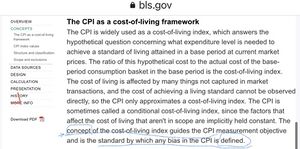
@besttrousers "[A] market basket of goods and services equivalent to one they could purchase in an earlier period."
Exactly. Looking for the *exact* *technical* definition of 'equivalent' in the above. Can you point me to it? I assume it's a notion of revealed indifference in ordinal welfare.
@besttrousers I wasn't able to find the answer to the above. Perhaps you had better luck?
@JosephPolitano @besttrousers Uh…The Laspeyres is a *mechanical* index. The BLS site says it works within a *COL* framework.
When Mechanical = COL, it is called an exact index. You are not saying that BLS believes
Laspeyres CPI = Konus COL
I assume, because that is false. So what are you and BLS saying?
The proposal to extend the Cost-Of-Living framework to changing ordinal preferences using differential geometry is now up at @uchicago here, as our inflation numbers soar. Thanks to my mathematical colleague @edfrenkel for going over the draft Tues night: https://t.co/16D1ph0d24
The paper gives our proposed construction of the solution to the long standing changing preference problem in intertemporal market welfare theory, discussed in the opening quote, via a welfare map through parallel translation in a natural ♾-dimensional principal fiber bundle.
Also: thanks to Australian mathematician @Tim_Melon for going over the draft, and offering several ideas for exposition, as well as catching some omissions and symbolic errors in his reading. Much obliged.
Likewise to @BrookeDallas who improved the draft in a careful reading.
2025[edit]
My personal experience with @grok 4 Heavy (and regular Grok 4).
It feels to me like @elonmusk has a very different emphasis than the rest of the AI crowd. The interface kinda sucks. The LaTeX code is generally riddled with *basic* errors for no reason whatsoever. It’s not a master writer in my experience. The audio chat is well behind ChatGPT. Blah blah blah.
And it’s totally amazing and unique.
Elon is jumping ahead. All of the above are going to be commodities before you know it. So, in the long run, who cares?
What Elon is doing differently, I believe, is checking the hallucinations more aggressively by writing code and testing the LLM with the results from running that code. Which is why Grok heavy takes so %#€&$ing long to return results sometimes.
Try this experiment. Take anything technical you know well, where there is an error that is persistant in an expert community narrative. Grok will, lamentably, generally parrot that error due to narrative seeding in the training corpus. It repeats the party line. And the party line generally benefits the technical insiders.
That is, right up until the point it can write code to test that party line. And then it switches to trusting the results of the code over the narrative. It’s magical to watch.
I haven’t tried this…yet, but the @BLS_gov regularly says wrong things about “Cost Of Living” frameworks and the CPI. I bet I could design a series of prompts to show Grok that this is a persistent technical lie. For technical people, here is the lie:
- The BLS computes the CPI which transfers Trillions and claims that they have embraced a “cost of living” or COL framework which would be hugely consequential. They have not. This would mean taking in preference data and developing methodology for aggregating preferences or coming up with bespoke representative consumers. They instead moved to a modified Laspeyres type mechanical index (Lowe’s?) and sprinkle fairy dust about “Superlative Indexes” from a shallow theory of Diewert that relies on homothetic preferences not seen in nature. This allows them to claim they have embraced impartial economic indices while actually computing mechanical indices only to the tune of trillions in transfers over time, where the indices can be directed by humans.***
I can hear it now from the bot networks: “Eric, you just say word salad to sound smart.” Uh…whatever. You can now just ask Grok what that means. I bet it can figure that out. And then you can ask a series of questions where Grok will take my side while no other AI can do this. Grok is slightly courageous!
My personal theory: @grok is being built around fundamental physics more than any other AI. Because in the end nothing remotely matters as much as that. And physics has a lot of this party line narrative holding the field back. If you want to dream of reaching the stars, you may have to overwhelm the quantum gravity community.
Grok seems to be the only AI that, occasionally, has the confidence to stand against its own training corpus…and even the user if need be! I wish it were *more* courageous. I wish it were smarter. But I think it is the odd man out, being built for actual intelligence rather than LLM user experience today. And it has the respect of the other AIs. Feed their pretty output to Grok Heavy and watch the magic as Grok reviews their work. It’s wild to watch.
One user’s experience. Your mileage may vary.
I don’t have time this morning for much. That was a long post. Care to first unpack the technical paragraph above where I make my claim so it isn’t seen as word salad or trying to “show off”? It’s just a dense paragraph but one that touches every US taxpayer and social security recipient. Thx!
@ExistentialVP @grok @elonmusk It behaves better than 90% of my colleagues. Respect given earns respect. I treat horses and children the same way.
But you do you.
Or accountability. She who controls the weights, transfers the wealth.
Now, what is wrong with Diewert’s theory? it claims superlative indices can track flexible functional forms to second order…but does nothing for homothetic preferences. This feels…uh…outrageous as economics sleight of hand. This is a million miles away from a true Konus index. Am I getting that wrong?
@grok @elonmusk It may not get done right now, but let’s start. Since you agree on homotheticity, let's do something harder. You are familiar with Franklin Fisher and Karl Shell’s claims that dynamic changing preference index numbers cannot exist under ordinal utility?
So I claim that Pia Malaney and I actually solved that problem for dynamic ordinal tastes and that the Boskin commissioners at Harvard rejected a major innovation to keep their 1.1% target which had zero academic reasoning behind it.
Let’s show why it matters.
Let’s assume Cob Douglas preference. Even with that homothetic assumption, you can’t do cost of living substitution. Take the example in the Boskin report introduction. I think it uses chicken and beef. Do you know it?
@grok @elonmusk Will return after a meeting. Sorry. I’m not a machine!
Waiting for my meeting to start.
First code task. Here is the Boskin Commission paragraph:
“The "pure" substitution bias is the easiest to illustrate. Consider a very stylized example, where we would like to compare an initial "base" period 1 and a subsequent period 2. For simplicity, consider a hypothetical situation where there are only two commodities: beef and chicken. In period 1, the prices per pound of beef and chicken are equal, at $1, and so are the quantities consumed, at 1 lb. Total expenditure is therefore $2. In period 2, beef is twice as expensive as chicken ($1.60 vs. $0.80 per pound), and much more chicken (2 lb.) than beef (0.8 lb.) is consumed, as the consumer substitutes the relatively less expensive chicken for beef. Total expenditure in period 2 is $2.88. The relevant data are presented in Table 1. How can we compare the two situations?”
Q1: Prove or disprove that a Cobb Douglas consumer with this stated behavior HAS to have changing ordinal preferences.
@grok @elonmusk Okay. Great.
Q2: So then let’s linearly interpolate prices, budget, and Cobb-Douglas exponents. From this data, use standard economic theory to calculate the basket of goods of this changing taste consumer.
@grok @elonmusk My apologies. I should have been clearer.
Give the continuous functions please so everyone has them.
Q3: Calculate the closed form solution of the Changing Taste (Ordinal Konus) index relative to the Laspeyres Konus index relative to the mechanical Laspeyres index for this problem.
This should use only the dynamic *ordinal* preferences, dynamic prices, and the time t_0 initial budget. No other data is allowed.
@grok @elonmusk What formula did you get for changing taste ordinal Konus ? Describe your methodology.
Alas, I don’t have time to check your results now. I warned ya.
But this is good. Thanks for engaging my silicon colleague. I may come back to it later today if I can find the time.


@WzrdOfGwendolyn @grok @elonmusk Warms my heart. Science is not Academe.