
Mansfield Amendment (1969): Difference between revisions
No edit summary |
|||
| Line 1: | Line 1: | ||
[[File:Mansfield-Amendment-1969-Cover.jpg|thumb]] | [[File:Mansfield-Amendment-1969-Cover.jpg|thumb|Implementation Of 1970 Defense Procurement Authorization Act Requiring Relationship Of Research To Specific Military Functions (Original Document)]] | ||
'''[https://www.gao.gov/assets/b-167034-d12080.pdf The Mansfield Amendment of 1969]''' was a provision (Section 203, Public Law 91-121) attached to the Military Procurement Authorization Act of 1970 that restricted the use of Department of Defense (DoD) funds for research. | |||
The amendment stated that DoD funds could only be used for research that had a '''direct and apparent relationship to a specific military function or operation'''. In effect, it prohibited the Department of Defense from funding basic or fundamental research that lacked an immediate, obvious military application. | |||
== Background and purpose == | |||
In the late 1960s, during the Vietnam War era, widespread anti-war sentiment on American university campuses led to criticism of the military's deep involvement in funding academic research. The DoD, particularly through the Advanced Research Projects Agency (ARPA, later DARPA), had become a major sponsor of broad scientific work in fields such as computer science, materials science, and behavioral sciences that often had no clear military purpose. | |||
Senator [[Mike Mansfield]] (D-Montana), the Senate Majority Leader, argued that funds appropriated for national defense should not be used to subsidize general scientific inquiry, a role that properly belonged to civilian agencies such as the [[National Science Foundation]] (NSF). The amendment was intended to curb perceived military overreach into academia and to ensure that defense appropriations were spent only on projects with direct military relevance. | |||
== Impact == | |||
The amendment had an immediate and lasting effect on U.S. military-funded research. ARPA was forced to terminate, rejustify with explicit military applications, or transfer many of its basic research projects. Notable examples include early work that led to the [[ARPANET]] (predecessor to the Internet), which had to be reframed or moved. | |||
Many fundamental research programs previously supported by the DoD migrated to the NSF and other civilian agencies. Although the strictest form of the amendment applied primarily to fiscal year 1970 and was later softened in subsequent legislation, it marked a permanent shift in American science policy, reducing the military's role as a patron of unrestricted basic research and pushing DoD funding toward shorter-term, applied projects. | |||
== On X == | |||
=== 2021 === | === 2021 === | ||
Revision as of 01:01, 29 November 2025

The Mansfield Amendment of 1969 was a provision (Section 203, Public Law 91-121) attached to the Military Procurement Authorization Act of 1970 that restricted the use of Department of Defense (DoD) funds for research. The amendment stated that DoD funds could only be used for research that had a direct and apparent relationship to a specific military function or operation. In effect, it prohibited the Department of Defense from funding basic or fundamental research that lacked an immediate, obvious military application.
Background and purpose
In the late 1960s, during the Vietnam War era, widespread anti-war sentiment on American university campuses led to criticism of the military's deep involvement in funding academic research. The DoD, particularly through the Advanced Research Projects Agency (ARPA, later DARPA), had become a major sponsor of broad scientific work in fields such as computer science, materials science, and behavioral sciences that often had no clear military purpose. Senator Mike Mansfield (D-Montana), the Senate Majority Leader, argued that funds appropriated for national defense should not be used to subsidize general scientific inquiry, a role that properly belonged to civilian agencies such as the National Science Foundation (NSF). The amendment was intended to curb perceived military overreach into academia and to ensure that defense appropriations were spent only on projects with direct military relevance.
Impact
The amendment had an immediate and lasting effect on U.S. military-funded research. ARPA was forced to terminate, rejustify with explicit military applications, or transfer many of its basic research projects. Notable examples include early work that led to the ARPANET (predecessor to the Internet), which had to be reframed or moved. Many fundamental research programs previously supported by the DoD migrated to the NSF and other civilian agencies. Although the strictest form of the amendment applied primarily to fiscal year 1970 and was later softened in subsequent legislation, it marked a permanent shift in American science policy, reducing the military's role as a patron of unrestricted basic research and pushing DoD funding toward shorter-term, applied projects.
On X
2021

@dvijmankad It's not that hard. The Manhattann project was filled with iconoclasts.
Also: Feynman's reception at Shelter Island after the war. Dyson's victory over Oppenheimer at the IAS. Watson vs Venter on the Genome. Smale on the beaches of Rio. Serge Lang at Yale. Schwinger's epigram.
A lot changed for reasons *other* than the "Endless Frontier".
@ellleighclarke @Burchoff Maxwell, Eilenberg, Bayh-Dole, Mansfield, Immact90, SSC cancellation, etc. We are down to embers. It’s not Witten and Greene. It was the lack of freedom to deviate from Witten and Company. To tell your failing elders that you won’t be signing on to their failed programs.
2022
1) General Relativity
2) (Pseudo-)Riemannian Geometry
3) Quantum Field Theory
4) Material Science/Condensed Matter
5) Nuclear Physics/Weaponry
6) Disinformation Theory
7) Cult Indoctrination/Deprogramming
8) Propaganda
9) Preference Falsification Theory
10) Mansfield Amendment

@LueElizondo recently gave a small list of topics he would recommend for study to begin to wrangle "the Phenomenon", if he "were king". What areas of intersectional learning do YOU think are needed and should be more deeply looked into? Your ufology curriculum. Thanks, Eric.
11) Science Policy Theory (V Bush)
12) Selection (Abstracted)
13) Comparative Eschatology
14) Anti-Gravity Pseudo-science involving top physicists and mathematicians in the era of the So-Called ‘Golden age of General Relativity’.
15) GU
16) Mind control.
Remember: you asked! ;-)

PrimaoMansfield amendment of 1969… or 1973?
Wow! Thanks for asking Dale. 1969…but 1973 is closely related.
Nobody gets this anymore. It’s like talking to the wind. Thanks for spotting that entry. Truly.
(Was supposed to read, “Primarily Mansfield Amendment…” but fat-fingered the iPhone word prompt)
Thanks for the reply!
I got it immediately. Stay in touch? Thx.
@ben_koski Last Question of the Night: where did the top mathematicians and physicists go after the Mansfield amendment(s)? How can you have UAP where I am the only voice loudly pointing out that Real Alien Vehicles would like require new physical law. We can account for every relevant PhD.
@ben_koski What happened with the Mansfield amendment & why does no one discuss this? We used to have our top people on this but we called it something else. Where did it go? Either it ended or it didn’t. It’s a tiny world. Just don’t get all Qanon. It’s a big story: Treat it w/ respect.🙏
One of the questions about UFOs that needs to be asked, and that I don’t hear much about, is: “Has the US government built fake UFOs?”
UFO people are so focused on whether there are real UFOs that they don’t push hard enough on this question.
Allow me to share a thought or two.

When I first realized I was totally wrong about UFO/UAP, I was shocked by how many folks have very similar stories about recovered crashes of very similar advanced vehicles.
It was mind blowing in 2 ways.
A) We have real crashed vehicles. And/Or B) We built fake alien vehicles.
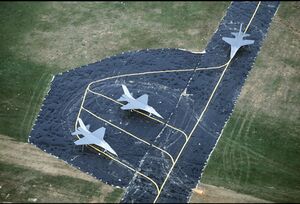
At this point I’m reasonably sure there are things that look like cool alien vehicle in some hangers. But I also grew up near Hollywood and remember super cool looking fake space cars visible off the Hollywood freeway.
So: does anyone have stories of building fake UFOs for USG?
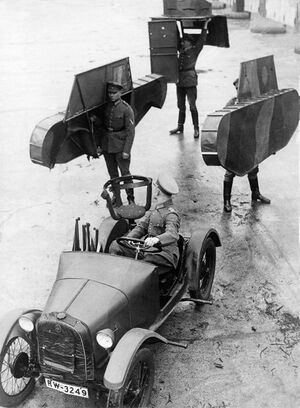
As you likely guessed, all the photos in this thread are fake military equipment. The airbase is totally fake. The dummy tanks are often inflated on the battlefield. The fake tank pieces are bolted on to real cars.
Q: Did we build fake UFOs in places like Wright-Patterson AFB?

After studying this issue for 2yrs, I’m pretty convinced that there ARE wild looking vehicles in secret high security locations. But I also find NO SIGN OF OUR TOP PHYSICISTS. That is a huge red flag. If you had fake UFOs, you would have a puzzle for physics: What is the science?
A true recovered interstellar craft would be like LHC or LIGO data: potential scientific data for physics beyond the Standard Model and General Relativity.
But if the crafts are fake, you would be crazy to let the A-team physicists near them. It would blow up in your face.
So my ignorant question is this: are there stories of building fake UFOs for sites in Nevada? Ohio? Are there fake retrieval teams? To what extent does faking military equipment spill into faking a UFOgasm for decades?
Because there are too many very similar craft stories.

So, at this point, the stories of craft kept at secret locations is most likely to be true in my opinion. But it is also true that all the top physics talent that was working only semi-covertly on suspicious gravity projects left by the early 1970s. So any craft may be faked.
Either way, it’s a big deal. Everything changed in the early 70s. It’s impossible to say how much. The moment the Mansfield amendment came in, physics began to stagnate. And “Quantum Gravity” destroyed our culture of science. We don’t even whisper about its “Anti-Gravity” origin.
Note Added: many readers are making wild inferences about me talking about flying fakes. I was very clear that this was about apparent crafts on the ground and in Hangars in Nevada, Ohio & elsewhere.
Wild or bad inference patterns will get you blocked. I don’t have time. Thx.
2023
We’ve been trying to destroy US scientists’ freedom & their research universities for ~60 years.
Peer Review 1965
Mansfield Amendment 1969
Eilberg Amendment 1976
Bayh-Dole Act 1980
IMMACT90 1990
SSC Cancelation 1993
ADEA Faculty Uncapping 1993
Dear Colleague Letter 2011
DEI 2017

When a successful polio vaccine candidate was introduced in 1953, it made its developer a minor celebrity.
In 1960, Time magazine’s “Man of the Year” was awarded to “US Scientists.”
What used to be people’s celebrity in the 1950s is seen by many as a villain today.
Why?
You are looking at domesticated Scientists that were bread over almost 60 years from Wild Type scientists.
It’s not that there is no connection. But the difference between a wolf & a poodle can be significant. One is fiercely independent. One needs obedience to be fed regularly.
And inside every domesticated animal lies an unkillable dream of being wild and free again. That’s why occasionally my dog brings me a squirrel or still pees on territory while on a leash.
Your real scientists want to hunt again. They need to be reintroduced into the wild. Now.
Here is the simple point:
You can have scientists you trust.
You can have scientists you control.
And you can pick only one of the above options.
You’re getting angry at wolves you bred into obedience to non-scientific masters who have no idea what they are doing. That’s why.
*bred. 🙏
Now I feel completely alone.
I want our wanting out of this story. I have a huge dog in this fight. I spend every day fighting my own human desire for GU to be proven correct.
I believe this is how String Theorists stopped being scientists.
I just want our data & the physics.

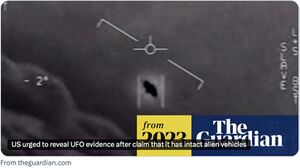
If biological aliens were here from others star systems in crafts that defy the current physics of the standard model and, more importantly, general relativity, I would be one of the few people who would have a guess on day one as to how they must have gotten here. It’s tempting.
I don’t think biological interstellar alien visitors using GR and the SM make much sense. So I try to have a war *inside* my own mind as to what is true. I have a genuine “Need to Know” as to whether this is BS NatSec space opera disinformation theater. Because to me, it is data.
What just happened isn’t data. It’s that a sober individual just pushed one of the many longstanding highly conserved NHI narratives collected from *many* diverse sober NatSec informants over the sworn testimony line. And it gets a LOT crazier from here. But it’s not science yet.
As I‘ve been saying, there is so much deliberate NatSec BS out here that our own scientists are being propagandized. We’re drilling holes in our own scientists’ lifeboat. Last time we saw this it was virologists/immunologists/epidemiologists being gaslit. Now it’s physicists.
Let me be very careful in what I am about to say. We have at least the appearance and optics of scientific self-sabotage. And wanting things to be true is how science dies.
I fight like hell to promote my theory. But I’d sign on to another to know the truth if I was wrong.
We may be looking at the birth of a new UFO religion. Or a moment of contact. Or a long running Disinformation campaign. Etc.
To go beyond GR, let’s be scientists & get NatSec out of our data first. Where is our data pruned of space opera disinformation and cultic religiosity?
What I want to know:
Why was the Mansfield Amendment passed?
Why did NSF fake a labor shortage in our MARKET economy destroying American STEM labor markets?
What stopped the Golden Age Of General Relativity?
Why was the SSC really cancelled?
StringTheory & STAGNATION: WTF?
What the hell was the 1957 Behnson funded UNC Chapel Hill conference actually about?
Why are we not stopping to QUESTION quantum gravity after 70 years of public *FAILURE* inspired by Babson-Behnson patronage of RIAS, the Institute of Field Physics and the precursor to Lockheed?
This is the 50th year of stagnation in the Standard Model Lagrangian. It is AS IF we are deliberately trying to forget how to do actual physics. Everyone who has succeeded in Particle Theory in standard terms is now over 70. This is insane. In 25 years there will be no one left.
Why are we not admitting that quantum gravity is killing physics and is the public respectable face of 1950s anti-gravity mania that lives on to murder all new theories in their cradle?
Quantum Gravity is fake and works to stop actual physics.
There. I said it. Now let’s talk.
If you want to know whether there are biological interstellar visitors here observing us, the short answer is “Almost *certainly* not if they are using our current stagnant non-progressing theories of physics.”
Let’s finally get serious about this whacky subject? Thanks. 🙏
I swear I didn't write my tweet to make you feel alone and I'm genuinely sorry if that was the result. That said, I think it's better to acknowledge one's hopes and desires than to pretend they don't exist and thereby overestimate one's own rationality.
@skdh I acknowledge my desires as you see from what I wrote. But a stagnant community always wants outcomes. It wants SUSY. Or Strings. Or some g-2 muon anomaly. Etc.
I want too. But what I want is mostly just a desire to get the BS out of physics so we can get back to succeeding.
@PitHumke @PRCrimsonThread @TheUfoJoe That is what I got. It doesn’t include the Mansfield amendment so far as I can tell. Amazing find.
2024
Many of you are asking for my reaction regarding the just released @DoD_AARO report. There is much to say. I want to think carefully before saying more. I am not unsympathetic to US National Security needs in this.
In February of 2023, @joerogan invited me for four hours onto the world's largest English Language program (episode #1945) to describe in detail the mystery of potential US Government involvement in UFOs and Post-Einsteinian physics during the mysterious "Golden Age of General Relativity". It has been seen and discussed by millions as expected. I was thus eager to see how thorough this report would be by combing it for search strings raised in my research.
REFERENCES:
"Glenn L Martin Company": 0
Bryce Cecile DeWitt: 0
Institute for Field Physics: 0
Research Institute for Advanced Study: 0
Louis Witten: 0
Roger Babson: 0
Agnew Bahson: 0
Gravity Research Foundation: 0
Gravity: 1 (pg. 32)
Rennaisance Technologies: 0
UNC Chapel Hill: 0
Solomon Lefschetz: 0
Freeman Dyson: 0
Herman Bondi: 0
Negative Mass: 0
"Scientific and Intelligence Aspects of the UFO Problem"
Australian Intelligence 1971 Report: 0
Australia: 0
George Rideout: 0
Edward Teller: 0
Robert Oppenheimer: 0
David Kaiser: 0
Wright-Patterson Air Force Base: 1 (pg. 18)
Curtis Wright Aerospace Buffalo: 0
Pascal Jordan: 0
Mansfield Ammendment: 0
Joshua Goldberg: 0
Office of Global Access: 0
University of Texas, Austin: 0
Center for Dynamical Systems: 0
Physics: 5 (pgs. 16-17, 53)
Relativity: 0
Albert Einstein: 0
George Bunker: 0
Welcome Bender: 0
George Trimble: 0
CONCLUSION: This report purports to have studied the questions raised surrounding UFO/UAP related research of the US federal Government. It, in fact, appears to have studied a carefully chosen SUBSET of the claims selected from among those which appear to have mass appeal to the so-called "UFO Community." It completely, or nearly completely, avoided reporting on all questions surrounding issues which have been raised in serious research and by PhD level researchers who have raised scientific questions in this area. This continues the pattern of using PhD level government scientists who appear to avoid the actual research questions most likely to involve sensitve Special Access Programs and Stovepiped Research which are compartmentalized by design. Whether the omissions are due to issues of avoidance, misdirection (e.g. so-called Limited Hangout strategy), ignorance or incompetance cannot be discerned from the information given.
RECOMMENDATION: It is simply not possible to treat the current AARO report as historically complete or comprehensive. To gain the public trust, the successor to AARO would have to expand and redo this analysis with input from domain professionals who are trusted by the public not to have an apparent agenda or government background (e.g. Prof. David Kaiser of MIT or Dr. Nima Arkani Hamed of IAS, Prof. Brian Keating of UCSD, Avi Loeb of Harvard) Otherwise, it is relatively easy for scientists to "Follow the Silence" in government reports to see what is *not* being addressed or discussed.

Today the DoD released our Historical Record Report Volume 1.
AARO’s report covers more than 70 years of the U.S. record relating to UAP, draws from interviews, archival research, and partnerships across government and industry.
Read it here: https://statics.dod.teams.microsoft.us/evergreen-assets/safelinks/1/atp-safelinks.html
This *is* what science looks like right now.
Does this sound like real science? Even at a passing level? Just see. Read it.
“People studying misinformation lean left for two reasons:”
Extraordinary claim. Supported by….? I mean…Huge if true! I would have thought there would be complicated effects of political economy in science funding as well. But there is no discussion of any such effects.
It’s just two causes. Who knew.
“1. scientists lean left, regardless of specialty, because they care about facts.”
I mean….damn. I don’t even understand the argument. It feels like “because” is doing all the work here.
No discussion of history (e.g. The Mansfield Amendment), incentive structures, institutional dependence. Just a bald assertion known as an appeal to authority. The author is a professor, after all. . “2. misinformation today primarily comes from the Right ("they're eating the dawwwgs!") which makes it worth studying and fighting against for people leaning left.”
Appeal to ridicule. Strawmanning. Yes, Donald Trump is no scientist.
But the Institutional Left has been wrong all over the place, no? On sex, heritability, public health, viral origins, migration externalities, and prediction of elections via failure to adjust for preference falsification at scale.
What is this? I don’t know. It’s not the science you grew up witb that changed everything and illuminated the world.
My point is not to vilify Dr LeCun. It is to point out what institutional science NOW looks like. It used to look totally different.
But in 2024, it looks like exactly like this.
This tweet ⬇️ below. Learn to spot it.
2025
Ah. Why are European-Americans suddenly so inferior at math since like 1998? Why are the people of Newton, Einstein, Dirac, Crick, Feynman, Heisenberg etc suddenly no longer able to do first rate science? Excellent question!
Do you want the brutal answer? Those "white kids" are being forced into trying to figure out how to capture the value created by those brown kids, because STEM careers in actual research have cratered in prestige, freedom, support and compensation. It's awful. But true. Do you want to raise a serf?
I'm torn. Which is why I fight for scientists to capture wealth; science is my life, but I cannot stand the exploitation and abuse.
You actually know this already, you just don't realize it. How many STEM researchers and research scientists have you seen at Mar-a-Lago in photos and stories? Name them. Try.
When you think modern AI do you think about the 8 authors of the Transformer LLM architecture that changed our entire world with one paper? Can you name them? Any of them? Or do you think Altman, Musk, Zuckerberg, etc. like the rest of us (myself included)? Be honest. You think C-Suite or Sand Hill road VCs.
The researchers simply vanish or become businessmen.
We too often erase the people who do the actual STEM research. The PhD most responsible for the GFP revolution in biology (Douglas Prasher) got to drive a shuttle bus in Alabama for his career. Those who exploited his research felt so bad that they flew him to Stokholm to watch *them* get the Nobel prize. It's totally insane. No one knows this because we keep looking to Billionaires...those who capture the most value...to represent STEM.
STEM rests on "SCIENCE COOLIES". That is what a UCSF lab head (PI) called his army of Chinese and Indian biologists in an interview with me around 2000: "My Science Coolies tell me..."
The absence of white kids is because they generally come from native English speaking families before the 1965 immigration act that have been in the US a long time. Thus they get accurate information that grueling STEM research careers are now a terrible investment due to STEM EMPLOYER practices (e.g. H-1B, illegal collusion, lobbying) and the abandonment of STEM by the Federal Government beginning with the Mansfield ammendment 50+ years ago. They will eventually almost all move from the lab bench, the blackboard and the command line to signing pieces of paper in VC shops or Private Equity or some such higher value endeavor. We in STEM are all being pushed from creating the value to capturing the value. It's awful.
"गोरे बच्चे यहाँ क्या कर रहे हैं?" or something like it is what I heard in New Jersey when our family traveled to the science fair. Literally asking "Why are there white kids here?" Can you imagine?? In New Jersey!
Those Tamil and Bengali Brahmins from English speaking households will soon leave research too, to be replaced by Nepalese and Biharis. Then they will all get the message as well and search for non-research jobs.
Before long you will see a push for Vietnamese and Cambodians. The Nigerians, Philipinos and Ethiopeans will be welcomed, but will soon depart in turn as the STEM employers continue to search for servants and 'coolies' anywhere they can find them. All using one bizarre mantra "The Best and the Brightest!"
Because the employers treat researchers like servants. Fungible geeks. That is the culture we have to break.
Those brilliant brown American kids winning our Olympiads will dream of flying Business Class. Maybe even First Class one day. Those equally brilliant white kids who would have loved to do science leaving the olympiads, now dream of not even being on the same airplane as long as they are also avoiding coach.
Sorry "Cornered Hindu". I hate it. But you asked. Don't shoot the messenger.
How about reaffirming the unsayable:
A) Research Universities are supposed to be dedicated to scholarship and discovery above all else. Not teaching. Not politics. Not incubating business spinoffs.
B) They are suppose to be exclusive. Not inclusive.
C) The professors are supposed to lead the university. Not the staff. Not the administrators.
D) Academics are not to be made precarious.
E) Even private elite universities are not really private. They are government funded to do the work that the market cannot.
F) The USG is in breach of the historical commitment to support blue sky science in US Universities.
G) Graduate students are workers disguised as students. Foreign students are a foreign workforce.
H) Peer review is astonishingly recent and doesn’t work.
I) There is a quasi military function to research universities. They are part of National Security. Patriotism matters.
J) Some fields do not deserve to be together on a level field. Biology and gender studies for example.
K) Some fields *may* now be too dangerous to be studied openly. Parts of physics, number theory and Machine learning leap to mind. This must be studied.
L) The AAU, NSF, NAS etc. have all conspired against the welfare of American scientists and their families. Scientists need to be in the rooms where their fates are determined.
M) The difference between a research university and a college takes place almost exclusively within three groups of people: Professors, Graduate Students, and PostDocs/Researchers/Visitors. It often takes place in the afternoons. In seminars. In Labs. Etc. If you aren’t part of that world you aren’t part of the University. You are working or studying in BigEd but not involved with the university itself.
N) The great man/woman theory is basically correct in academics. Individual academicians change the world.
O) The Mansfield amendment, Dole-Bayh, Eilberg, IMMACT90 etc laws need to be undone. The damage has been incalculable.

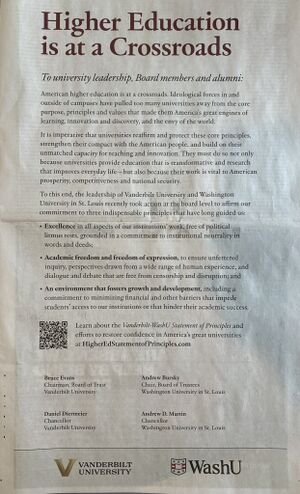
Full page ad in today’s WSJ taken out by leaders at @VanderbiltU and @WashU:
Higher Education is at a Crossroads
To university leadership, Board members and alumni:
American higher education is at a crossroads. Ideological forces in and outside of campuses have pulled too many universities away from the core purpose, principles and values that made them America's great engines of learning, innovation and discovery, and the envy of the world.
It is imperative that universities reaffirm and protect these core principles, strengthen their compact with the American people, and build on their unmatched capacity for teaching and innovation. They must do so not only because universities provide education that is transformative and research that improves everyday life—but also because their work is vital to American prosperity, competitiveness and national security.
To this end, the leadership of Vanderbilt University and Washington University in St. Louis recently took action at the board level to affirm our commitment to three indispensable principles that have long guided us:
-Excellence in all aspects of our institutions' work, free of political litmus tests, grounded in a commitment to institutional neutrality in words and deeds;
-Academic freedom and freedom of expression, to ensure unfettered inquiry, perspectives drawn from a wide range of human experience, and dialogue and debate that are free from censorship and disruption; and
-An environment that fosters growth and development, including a commitment to minimizing financial and other barriers that impede students' access to our institutions or that hinder their academic success.
Learn about the Vanderbilt-WashU Statement of Principles and efforts to restore confidence in America's great universities at HigherEdStatementofPrinciples dot com
Bruce Evans
Chairman, Board of Trust
Vanderbilt University
Andrew Bursky
Chair, Board of Trustees Washington University in St. Louis
Daniel Diermeier
Chancellor
Vanderbilt University
Andrew D. Martin
Chancellor
Washington University in St. Louis
I find myself in agreement with @realchrisrufo on this point.
I'll fill a bit in as well that doesn't seem to be well known.
Our private research universities are not actually purely private. They are designed to be both a cryptic soft extension of the state (e.g. national security, priming the prosperity pipeline with blue sky research, truth adjudication, etc.), which is also oppositely intended as an independent check on the state and state power in times of abuse as well. This tacit and quiet knowledge, which used to be held at the AAU and the relevant professors, has been mostly lost.
So 'overhead' or 'indirect costs' is not actually overhead at all. It is supposed to be cryptic state support based on research merit to avoid political pressure to fund 3rd tier universities at the same level as Princeton. So the whole system was designed back in the Vannevar Bush era but without leaving the esoteric knowledge with modern academicians.
It's a disaster. It was a quiet game which worked brilliantly to serve the nation and its population until lunatics started to get a foothold in the research universities.
This is why when you audit this stuff, you see waste. It wasn't ever intended to be what it appears to be: this was the USG paying to have a totally ELITE and EXCLUSIVE quasi-private, quasi-public resource. Think Manhattan project. Think The Jasons. Think winning.
And, despite my deep dislike of how @realchrisrufo has acted towards me, his point is spot on. If the elite U.S. universities are so confused as to think that they are truly 100% private and that they should be allowed to destroy their role of ELITE service to the nation which built them up with federal dollars, that is a moment to remind them of the "Endless Frontier" agreement.
First the USG welched on the agreement with the Mansfield Ammendment and Dole Bayh and then IMMACT90. Then the universities welched with DEI.
BOTH parties need to get back to the quiet agreement, or the whole thing will just fall apart. And the US research achipeligo is a *MAJOR* part of american greatness which we seem to be about to destroy because we can't figure out how to do this.
[And for those of you who seem to believe that quiet and tacit agreements are always bad, so that the Manhattan Project should have been academic and totally open because 'Sunlight is always the best disinfectant!!', I highly encourage you to use the comment section to complain again about elitism, gatekeeping, Fauci, experts, science, government and credentials. I get it. You can't stop to listen...or think. I totally get you. Looking forward to your vitriol. Just make sure to remind me repeatedly that markets are always right, all tax is theft, DEI is poison, and that Trump and Elon know exactly what they are doing at all times.]

The Ivy League universities are in a bind: they want to collect billions in federal funds, while openly violating federal civil rights law. The president should drop the hammer—no DEI, or no federal dollars.
The title of this @joerogan clip from #1945 is literally: "We might be faking a UFO situation."
OBVIOUSLY.
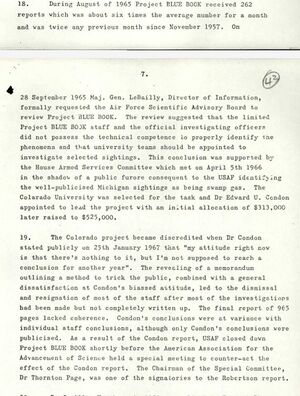
As I have said before, "When we do something secret and cool, we generally pair it with something fake." This is standard operating proceedure (e.g. Operation Overlord was D-Day/Operation Fortitude was a Faked Norway Invasion). This is what 'Covert' means. Covert means 'Deniable'. Not secret, but *deniable*.

BOMBSHELL: Pentagon created fake UFO evidence, promoted false alien stories https://nypost.com/video/bombshell-pentagon-created-fake-ufo-evidence-promoted-false-alien-stories/

Imho, This @nypost article is **NOT** the big story. That is coming.
CLAIM: We will find that there is a minimum of *one* pair of fake/real programs and that it is much much bigger than the hazing ritual being reported. But, more importantly, there are likely many more such pairs of REAL/FAKE programs in this area.
Yes: we fake UFOs. And yes, there is a REAL Aerospace program that hides under cover of the FAKE UFO program.
But this is not about an Air Force Hazing ritual. This isn't a prank. This is a whole life ruining program where we will find that we regularly destroy the minds of our own people with disinformation and threats to their mental health and families. Military heroes. Scientists. IC spooks.
The real FAKE programs are bigger than this. And the REAL program is also bigger than just conventional Aerospace. I wish to mark this claim now: eventually, this is going to be about the actual SCIENCE of Physics.
I don't think Quantum Gravity as it is practiced is a real research program. It is the obvious candidate for the "inhibitor" that, when added to research, stagnated physics...and it didn't come out of some longstanding program from the birth of quantum mechanics. It came out of nowhere right before we stopped making progress on the Lagrangian of the real world.
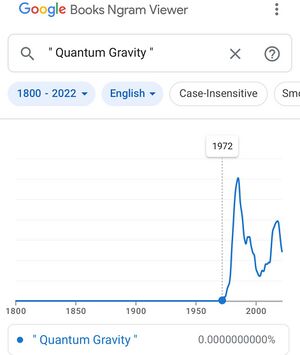
This is going to explain what @pmarca keeps talking about with @bariweiss, @bhorowitz and others: we took whole areas of physics off line after the Manhattan project and that was *NOT* limited to just the Nuclear Physics of nuclear warheads.
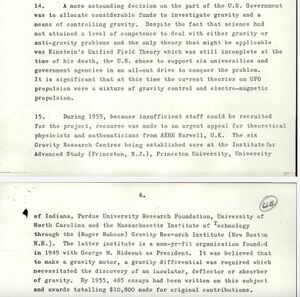
CLAIM: These FAKE and REAL programs will keep going and extend to "The Golden Age of General Relativity". We will eventually learn that the mysterious philathropists Roger Babson and Agnew Bahnson who funded Louis Witten and Bryce deWitt (respectively), along with others were (obviously) NationalSecurity cutouts. They were real people giving cover to some major Post-Manhattan physics thing.
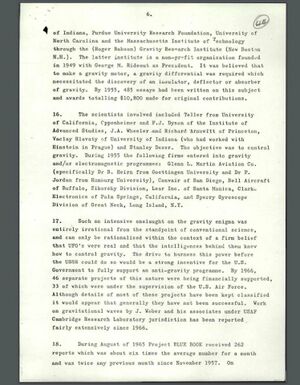
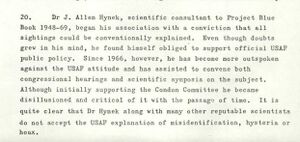
From Australian Intelligence (circa 1971) we have this which I both believe and hypothesized LONG before finding it:
It's time to come clean. The disclosure is coming. One way or the other. A so-called "Limited Hangout" is impossible in 2025. This is not going to work. There is too much information out here already:
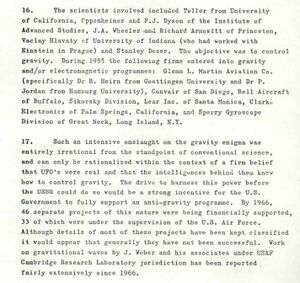
Claim: We are going to learn that just as public work on chain reaction physics mysteriously vanished during the Manhattan Project, research in fundamental physics changed character TWICE. Once in the late 1960s-early 1970s with the Mansfield Amendment, after the quark model and spontaneous symmetry breaking and then more dramatically around 1983-1984 shortly after the catastrophic disclosures of Howard Borland and John Aristotle Philips to handle the "Streisand Effect" problem, which had no such name at the time.
Eventually we learned why progress immediately stalled in physics due to secrecy and the building of the atomic bombs. We have an obvious second candidate and we aren't allowed to ask questions about why we aren't getting back to real physics in open universities. The dangerous and powerful kind that can build prosperity, weapons, energy, travel, propulsion and insight.
We have now found out that we were lying to our own people. As I predicted to you all.
I predict that this is **way** more interesting. This revelation about the lies is just the beginning. And it may have nothing whatsoever to do with NHI or flying saucers.
But either way, let us be bold enough to ask for the *full* lie. About our own history. Our science. Our Intelligence Community. Our Defense Contractors.
It's our country after all. At least supposedly...
🙏
Respectfully. Here is what I think is going on.
I) Independent breakthrough science is in a long wind down starting with the Mansfield amendment, and is being partially decommissioned. Why? Because it was found to be too powerful and redistributive.
II) The National Security and National Interest folks now use science, journalism, academe etc to dump their cognitive sludge. Epstein cover stories, UAP cover stories, Assasination cover stories, COVID cover stories, Inflation/Money Supply cover stories, etc. That is, the organs that kept us partially free in 1975 are now used to attack our ability to think, every day of our lives.
III) Anyone not going along with I) and II) sticks out like an absolute sore thumb and is targeted for “Image Cheapening”. This is abhorrent abuse of power.
IV) @RepLuna isn’t stupid. If she can talk about Physical Law and “Interdimensional beings”, she can place a phone call or two to our physicists or differential geometers/topologists. I’m happy to help direct her to good folks.
V) The UFO community is way too recreational. What ever is hidden behind the UAP curtain is serious business. It involved high level physics as recently as 50 years ago. Then that connection got buried. I just don’t know what this about. And I have *zero* proof it involves aliens or interdimensional beings.
VI) Adults who would never discuss the Tooth Fairy in public should not discuss alien equivalents of the Tooth Fairy. Alien life and higher dimensions are both super serious subjects to me. And they would be too you too if this wasn’t made into a cheap farce. Space opera is just dumping cognitive sludge in the middle of a central scientific question. And I don’t take kindly to it.
VII) I personally believe there are 4+6=10 =(d**2 + d)/2 for d=1+3 additional dimensions available for travel. But that would make **US**….humans….just as interdimensional as alien life. And we don’t evaluate any such ideas for our own travel. We just run out the clock listening to decades of the same 20 Octogenarians and Septuagenarians discussing how they are going to solve “Quantum Gravity” when they grow up. And we let them destroy all competitors so they can take down the field of theoretical physics and die in piece pretending they were the “Only Game In Town”. Which is total pure unadulterated anti-scientific bullshit. Think about it.
VIII) Nobody but nobody is this dumb. Not even the government on its worst day. This is national security cognitive sludge being dumped into science. We are 40+ years into a string theory fairy tale about “Quantum Gravity” without asking “Is this all bullshit?”
IX) Science needs to be in a dialogue with NatSec. And it needs to tell them to play nice and cut it out or we use our vast tools to figure out what is going on because this COVID level bullshit is too dumb to be believed. We are just one or two rogue billionaires away from being able to immunize our scientists from USG cutting off all funds and destroying their reputations. Breakaway science in the public interest. It can take as few as one personal fortune in the service of science to cure this. Just one. This whole post-WWII system of journals, peer review, grants, gatekeepers etc in fields like physics, economics and math is entirely vulnerable. We need to own
X) Lying about COVID and UAP is a modified NIMBY issue for all scientists: Not in our back yard(s). I’m just tired of scientists and technical folks being fed cognitive sludge by NatSec and national interest types we can’t see. Interdimensional or otherwise.
See Also
- Bayh-Dole Act (1980)
- The Evolution of U.S. Science and Defense Research Policies
- Eilberg Amendment (1976)
- IMMACT90
- Science, The Endless Frontier (1945)
- Science Since Babylon