
Marginal Revolution: Difference between revisions
No edit summary |
No edit summary |
||
| Line 185: | Line 185: | ||
|content=One of the things my trolls like to point to is outrageous claims. | |content=One of the things my trolls like to point to is outrageous claims. | ||
One of my most *outrageous* is that my joint work on a 2nd Marginal Revolution for economics was scuttled by the Harvard Department of Economics Boskin Commissioners. | One of my most *outrageous* is that my joint work on a 2nd Marginal Revolution for economics was scuttled by the Harvard Department of Economics [[Boskin Commission|Boskin Commissioners]]. | ||
Yet it’s admitted: | Yet it’s admitted: | ||
Revision as of 03:15, 18 March 2026

My tweet at the Junto spent part of today atop economics' top-rated "Marginal Revolution" blog: How can this be used for something big?
CLAIM: Gauge Theory is the natural marginalism for economics. CHALLENGE: help launch a 2nd marginal revolution virally via social networks.
One of the greatest articles I’ve read. An honest case for professional dishonesty. And professional dishonesty has been at the heart of my deep deep disagreement with @Noahpinion.
This, at least, we could discuss! I hate this. Despise it.
Now with that said: Read this piece!

Today's Substack post is about when and why the experts lie.
https://noahpinion.substack.com/p/yes-experts-will-lie-to-you-sometimes
Noah is justifying professional lying by experts ethically with one hand to take that freedom to professionally deceive with the other hand on grounds of difficulty, training and efficacy.
Hence our different views.
Noah points out that he is discouraging lying. Technically true and that is what let him write the piece.
But read it closely. The reason not to lie is that experts don’t have the training to do it as well as they would need to because it is difficult.
Thus the issue is this.
The piece is about discouraging professional dishonesty.
Ah. Technically Noah. Not ethically.
Your point is that lying well to the public is hard because experts aren’t trained to lie well and it’s a difficult task. I hear you. If we could lie well, and ethically we should do it. That’s the undercurrent. You are for truth practically.
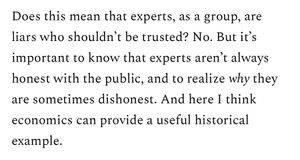
I don't discount the possibility that the "Noble Lie" could work, but I'm saying that experts tend to greatly overestimate their ability to make it work. Hence humility dictates that experts should be far more reluctant to resort to that tactic...
And as a fellow expert I’m done with being noble lied to by expert midwits.
Economists lie to people smarter than they are to destroy their careers.
And Noah: Fuck. That. Shit.
It’s professional malpractice. Not an efficiency question. Deal with it. Or continue on as before.
"Economists lie to people smarter than they are to destroy their careers." <-- Well I'd certainly never let my career get destroyed by being tricked by someone dumber than me ;-)
Maybe you never discovered the second marginal revolution in your thesis. But hey, I’m just making shit up.
Have a look at the physics of Wall Street. Last chapter. It’s covered by your brilliant article. Bravo.
I would actually love to discuss this. You have written something important. We are divided by the professional ethics. I think it is an actual disagreement.
Have me on your podcast?
Yes!
One of the things my trolls like to point to is outrageous claims.
One of my most *outrageous* is that my joint work on a 2nd Marginal Revolution for economics was scuttled by the Harvard Department of Economics Boskin Commissioners.
Yet it’s admitted:
https://ritholtz.com/2010/01/why-michael-boskin-deserves-our-contempt/
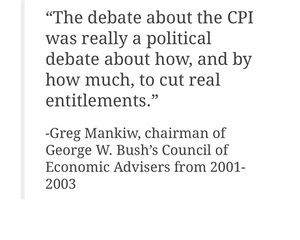
It’s kind of an interesting puzzle. Why is it that a Harvard Professor (Mankiw) can say the truth which is that this was a conspiracy to cut entitlements. But the only two people who can CALCULATE a COLA for changing tastes are crazy for saying their work was deliberately buried?
In any event, I stand by my claim. The Boskin Commission was organized by Moynihan and Packwood to deliberately break the CPI in a precise amount to avoid the US paying 1 trillion dollars over 10 years.
And I promise you no leading economist will call bullshit to debate this.
On of the reasons is that one of the commissioners bragged about this being the motivation behind the scenes.
Okay. So why can’t we have gauge theoretic economics reevaluated? Everyone admits this is what happened. Why continue to bury the advance?
I dunno. But it’s amazing!
The moral of the story to me is this:
We can’t have outside folks calculating and theorizing while the inside economists are fudging and cooking the books.
And calling me crazy won’t change a thing when this is finally understood. It’s simply institutional academic malpractice.
I am wholly supportive of this effort. Whether this iteration succeeds or fails is immaterial. The important thing is to take inflation away from those who would disguise:
A) The printing of fiat money by central bankers.
B) The fact that economists are holding back the field.
We can’t afford for economics to pretend it is a science in public, yet act as an incentive operated consultancy which can get you any result you need to fit the political agenda.
So this effort of @balajis needs to be supported! We must take this away from our current leaders.
Around 1996, Boskin Commissioner Jorgensen held back the biggest unambiguous advance in mathematical economics that I am aware of in decades. It would have interfered with their finding that the CPI was 1.1% overstated. He calculated 1.1% would save a round Trillion for U.S.
Why are they holding back the theory of index numbers (CPI, GDP)? Because the more innovation, the less freedom to dial our gauges to whatever values the political patrons of macro economics ask. The field is literally held back by leading economists to preserve their own power.
The co-developer of gauge thy in econ as a 2nd Marginal Revolution is Pia Malaney in the early 1990s at Harvard.
There is no reason to pretend this inflation thy never happened just to flatter power. Let’s disintermediate the old:
Lastly, it is high time my co-developer of the theory got her due without being subjected to both the Matilda & Matthew effects. Man-boys really do drive technical women out of technical fields because they can’t cite a woman who is smarter than they are. Enough.
Go @balajis.
Inflation is like a thermometer. You ask how hot/cold it is. You don’t get to ask “What do you need the Gauge to say? How much thumb should be on the scale?”
This is all discussed in detail by Jim Weatherall in his book in the final chapter/epilogue:
I think this is a great introduction to geometric marginalism and economic field theory. Hope you love it:
This eliminates a step or two. You may have to watch in lower resolution if you are on your phone however:
ANNOUNCEMENT: I head next week to @UChicago for 5 days (Nov. 8-12) at the request of its storied Department of Economics to present our theory that all of economics is based on the wrong version of the differential calculus.
Importantly, this error afflicts Inflation & the CPI. https://t.co/YKaPHjpdtq

Please retweet the top tweet if you're followed by economists & others interested in the debate over inflation and CPI, and your followers would find a new geometric Marginal Revolution of interest. Thanks! cc: @tylercowen, @Breedlove22, @paulmromer, @PeterMcCormack, @EconTalker.
I am a huge believer in the University of Chicago and its ability to stay the course while all others bend to the prevailing winds.
As such, I may (or may not) be announcing other events to discuss other work (e.g. Geometric Unity) depending on time, interest & availability.🙏
Cc: @balajis, @HarvardEcon, @BLS_gov, @ethereum, @VitalikButerin, @paulkrugman, @MarcusduSautoy, @BitcoinMagazine, @brian_armstrong, @CoinDesk, @coinbase, @stevesaylor, @naval, @pmarca, @saylor, @Noahpinion, @UChicagoPhysics.
My understanding is that there will be a zoom link.
@curious_sausage @tylercowen @Breedlove22 @paulmromer @PeterMcCormack @EconTalker @ProfSteveKeen I never do! He’s great…and thanks for the reminder.
Cc:@nntaleb, @DrBrianKeating, @edfrenkel, @ProfSteveFuller, @ProfSteveKeen, @INETeconomics, @steve_tadelis, @JonHaidt, @bariweiss, @ggreenwald, @greggutfeld, @RHDijkgraaf, @SimonsFdn, @QuantaMagazine, @inferencereview, @BretWeinstein, @PiaMalaney, @fullydavid, @SamHarrisOrg.
@nuckynucker @UChicago I didn’t think it was closed. It’s an academic talk mind you, but most such talks are open.
@AgramSeth @nuckynucker @UChicago I am hearing that this event is not open. I, however, *am* open to doing an open event on the same material.
@_PeterRyan @UChicago Weird question. You seem to have me confused for the BLS. I don't take in Data. I don't have a staff or a budget. You're assuming that I have the 'Real Inflation & CPI numbers'. I don't.
This is about not even having a correct *theory* to calculate. What we corrected was theory.
@_PeterRyan @UChicago I didn’t say what you said. I said there was a wrong theory for CPI. We corrected that theory.
The issue of how to implement a theory in practice leases to different data being collected and different aggregations. For a different theory, you would collect different data.
@_PeterRyan @UChicago As an example. The Boskin commission gave a single illustrative example in their report using two goods, chicken and beef. They gave prices but not ordinal utility. Here is the COL answer assuming Cobb-Douglas and Linear interpolation of all quantities. They could not compute it. https://t.co/zUgd1LwBgx
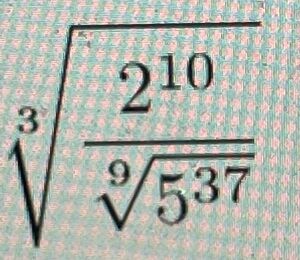
@_PeterRyan @UChicago The reason they had no theory to cover it was because the C-D exponent changed. And there is a claim that no extension of the Konus COL exists for dynamic tastes.
Hope that helps with your confusion. Be well.
@_PeterRyan @UChicago *leads not leases in the above.
@_PeterRyan @UChicago Well I think the BLS should begin by questioning their own premises. They say they work in a COL framework. They do not. They do not share how they construct the representative consumer. How they estimate substitution if they don’t have preference data. It’s fake and a mess.
@_PeterRyan @UChicago If they are going to do COLas they should estimate preferences. If they aren’t they should do mechanical index theory.
But I would use a bunch of that money to develop a research program on preference collection/imputation for substitution bias if I was running a COL shop.
@_PeterRyan @UChicago I am not sure. But the first question I have is do we believe ordinal preference maps are constructable from revealed preference.
@_PeterRyan @UChicago I would take a look at Paul Samuelson’s Nobel lecture. He goes into depth on revealed preference and preference field non-integrability. I think we have lost track of the fact that integrability of tastes was never actually settled except by fiat. Will talk on this.
 This article is a stub. You can help us by editing this page and expanding it.